Can Every Solitaire Game Be Won? Solver Results for 19 Games
No. Not every game of solitaire can be won, and the share depends on which solitaire you mean. About 99.999% of FreeCell deals can be won, but only three Baker's Game deals in four. Klondike, the game most people call solitaire, can be won 90.5% of the time when you draw one card and 81.9% when you draw three, if you could see every card. Four-suit Spider, which feels hopeless to most players, is about 98.5% winnable with every card known.
We know this because every solitaire game on this site has a solver behind its Hint button and its Winnable option. For this article we pointed those solvers at 10,600 freshly shuffled deals across 19 games and variants, then checked the results against the published research. Below are the results, the method, and four widely quoted figures that are wrong.
The short answer
Shares of random deals our solvers proved winnable, with the best published figure beside it where one exists:
- FreeCell: 99.9% proved winnable (999 of 1,000), none proved lost. Published: 99.999%, about one impossible deal in 84,000.
- Baker's Game: 76.5% winnable (765 of 1,000), the other 235 proved lost. Published: 75.05%.
- Klondike, draw one: 86.0% proved winnable (860 of 1,000), 21 proved lost, 119 not settled. Published: 90.5% if you could see every card.
- Klondike, draw three: 74.2% proved winnable (742 of 1,000), 97 proved lost, 161 not settled. Published: 81.9% with every card visible.
- Yukon: 86.0% proved winnable (860 of 1,000), 43 proved lost, 97 not settled. We found no published figure.
- Pyramid (three passes): 68.1% proved winnable (681 of 1,000), 268 proved lost, 51 not settled. Published figures exist only for other pass rules.
- Canfield: 58.4% proved winnable (584 of 1,000), 94 proved lost, 322 not settled. Published: 67.6% to 71.2%, depending on how piles may move.
- Spider: one suit 98.0% proved winnable (294 of 300), two suits 89.0% (267), four suits 38.7% (116). Not one Spider deal was proved lost. Published, four suits with every card known: 98.5%.
- Forty Thieves: 20.3% proved winnable (61 of 300), 1 proved lost, 238 not settled. No published figure exists that we know of.
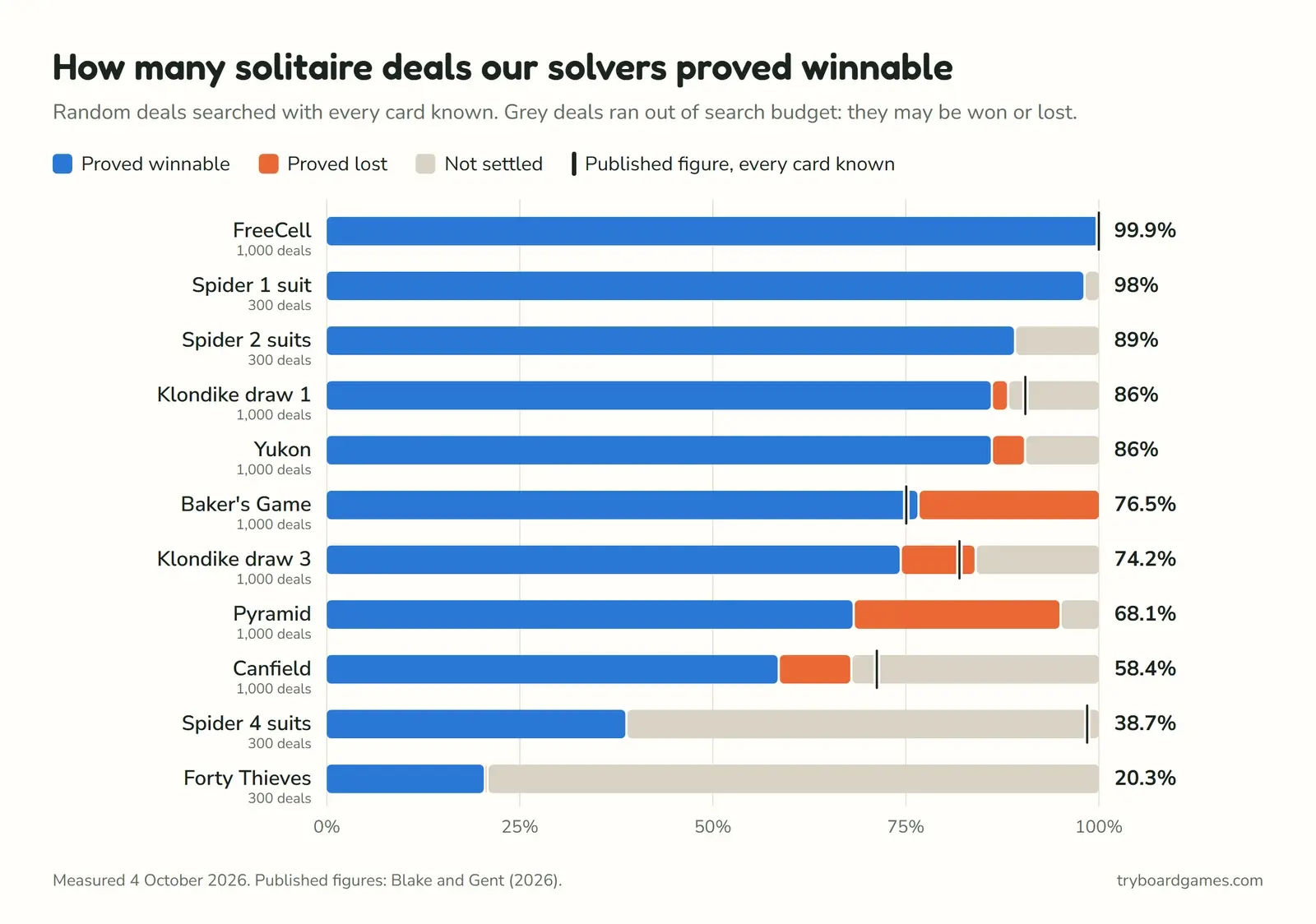
Grey deals are not lost: they ran out of search. The black tick is the published figure for the same rules, where one exists.
Three different numbers that get mixed up
Most articles on solitaire odds give one percentage per game and never say what it measures. There are at least three different things it can mean, and they are far apart.
- Winnable with perfect knowledge. If you knew where every face-down card was, could the deal be won? Researchers call this "thoughtful" solitaire. It is the number solvers can actually settle, and it is the one in the research below.
- Proved by a solver within a limit. A solver that gives up after a fixed amount of searching reports three outcomes: won, proved lost, or not settled. The proved share is a floor. The real share is somewhere between that floor and the floor plus everything left unsettled.
- Won by people. In Klondike you play without seeing the face-down cards, so you will lose deals that were winnable. Nobody has measured how often the best possible player would win in normal Klondike play. The best published bound says a good strategy wins more than 35% (Bjarnason, Fern and Tadepalli, 2009).
Our figures are the second kind. Where research gives the first kind for the same rules, we put the two side by side. In games where every card is dealt face up, like FreeCell and Baker's Game, nothing is hidden, so the first number is also what a perfect player could win.
How we measured
- Deals. Each deal is a seeded random shuffle of the deck, the same way the games deal when you press New deal. We used 1,000 deals per game, and 300 for the slower Spider and Forty Thieves searches.
- Solvers. The same solvers that run the Hint button and the Winnable deals option, with every card known, face-down ones included. Most are best-first searches; Klondike and Pyramid use depth-first search with a memory of positions already seen.
- Budgets. Each deal was searched at several limits, counted in board positions examined, from a few thousand up to two million. A deal is reported lost only when the search has tried every position the deal can reach without finding a win. A deal that runs out of budget is reported as not settled, never as a loss.
- Checking. Every winning line a solver claimed was replayed move by move through the game's own rules engine and had to end on a won board.
- Rules. Klondike allows unlimited passes through the stock and moving cards back off the foundations, the same rules as the main research figure. Pyramid allows three passes through the stock and is won when the pyramid is cleared.
All runs were made on 4 October 2026.
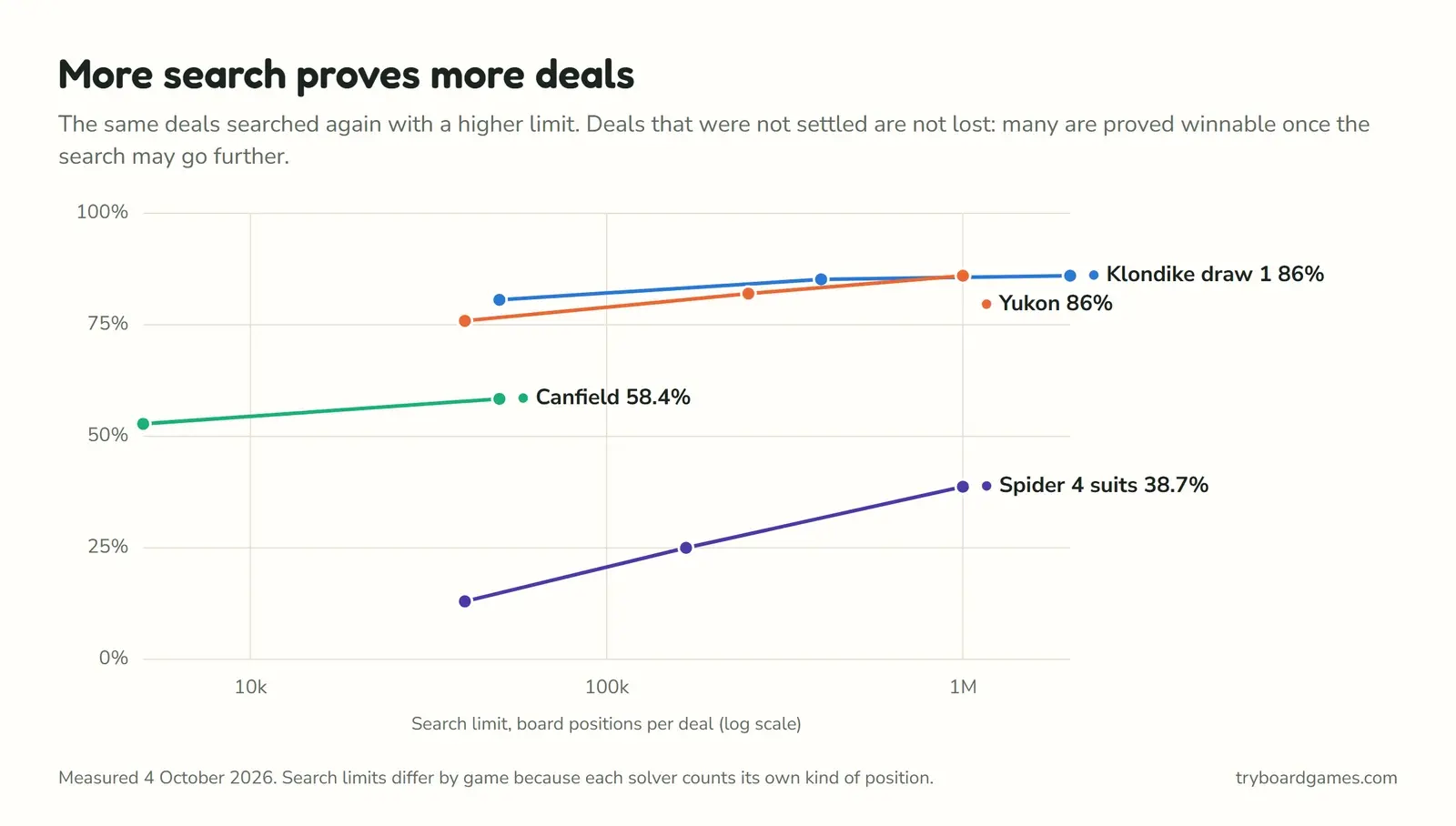
The same deals searched again with a higher limit. Not settled does not mean lost.
Game by game
FreeCell: practically always winnable
About 99.999% of FreeCell deals can be won; roughly one in 84,000 cannot. In our run, the smallest budget we tried, 5,000 positions, already proved 942 of 1,000 deals. At 100,000 it proved 993, and at a million 999. The last deal was not proved lost either; it was left unsettled. That matches what is known. Microsoft's original 32,000 numbered deals have exactly one that cannot be won, deal 11982. Shlomi Fish's Freecell Solver checked about 8.6 billion FreeCell Pro deals and found 102,075 impossible ones, roughly one in 84,000.
The free cells are what make the game so forgiving. With three cells instead of four, published figures still put winnability at 99.4%. With two it drops to 79.5%, and with one to 19.3% (Blake and Gent, 2026).
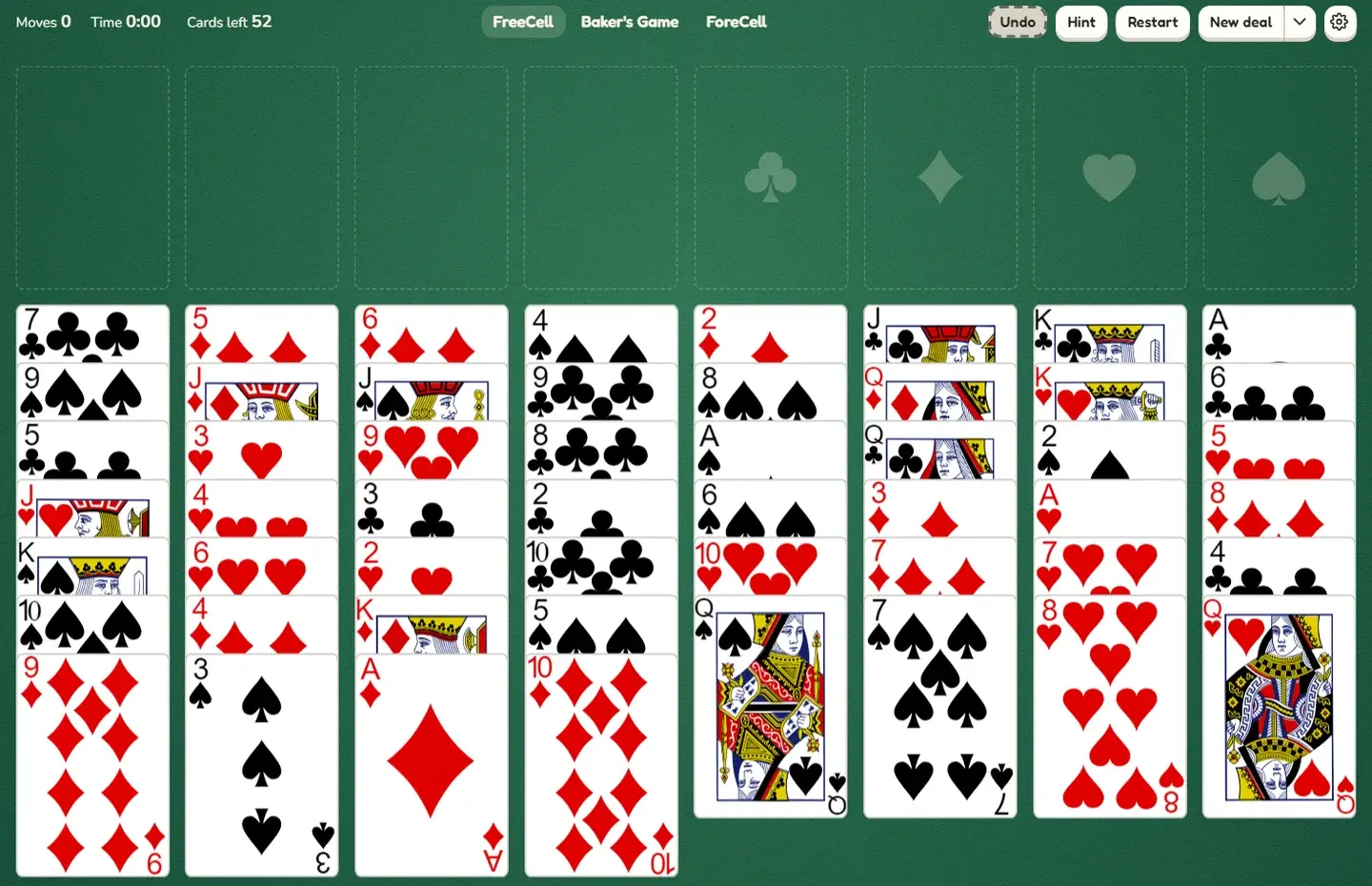
Every FreeCell card is dealt face up, so the solver sees exactly what you see.
Baker's Game: the same layout, a quarter of deals lost
Baker's Game is FreeCell with one change: you build down by suit instead of by alternating colour. That single rule costs about a quarter of all deals. Our solver settled every one of its 1,000 deals: 765 winnable, 235 proved lost. Blake and Gent's 10 million deals give 75.05%. Our 76.5% is about one standard error (1.4 points) away, which is what you would expect from 1,000 deals.
Klondike: eight or nine deals in ten, with every card known
With every card known, 90.5% of draw-one Klondike deals and 81.9% of draw-three deals can be won. Our Klondike solver searched each deal for up to two million positions, knowing where every face-down card was. For draw one it proved 860 of 1,000 deals winnable and 21 lost, and left 119 open. For draw three it proved 742 winnable and 97 lost, with 161 open. So by our count draw one is somewhere between 86.0% and 97.9% winnable, and draw three between 74.2% and 90.3%. Drawing three cards at a time costs roughly one deal in ten, because the card you need is often buried in the middle of a group of three.
The best published figures come from Charlie Blake and Ian Gent's Solvitaire solver, run on about a million random deals: 90.48% winnable for draw one and 81.945% for draw three, both with every card known in advance. Both fall inside our ranges. Set against them, roughly four in ten of the draw-one deals our solver left open, and about half of the draw-three ones, must be winnable. The rest cannot be won, but take more search to prove it.
What a player can win in normal Klondike, without seeing the face-down cards, is much lower and is not known exactly. Even with every card visible, people find it hard: in a Stanford study of thoughtful Klondike, a computer strategy won about twice as many games as an expert human player (Yan and others, 2004).
Spider: hard for our solver, almost always winnable in the research
With every card known, almost every four-suit Spider deal can be won, and our solver proved 98% of one-suit and 89% of two-suit deals winnable. Spider deals 54 of its 104 cards into ten piles, most of them face down, and you clear the table by building full runs from King to Ace in one suit. It is one of the hardest games here for a solver: a won four-suit game took about 370 moves in our runs, and every one of those moves had many alternatives. Searching up to a million positions per deal, our solver proved 294 of 300 one-suit deals winnable, 267 two-suit deals and 116 four-suit deals. It did not prove a single Spider deal lost, in any version. Everything it did not win ran out of search.
The research says those unsettled four-suit deals are very likely winnable too. Blake and Gent's solver, also with every card known, won 9,731 of 10,000 four-suit deals and lost none, leaving 269 unresolved. The paper puts the share at 98.5%, give or take 1.5 points. Alex Robinson's plspider project, with the help of human players, reports the first 65,000 numbered deals of WinSpidr and of PySolFC as solved, apart from one deal in each. We found no published solver figure for one or two suits, so ours are the first we know of. What players actually win is a different matter, because they cannot see the face-down cards, and that is the most likely source of the low numbers quoted for four-suit Spider.
Yukon: no published figure, so here is ours
Yukon deals every card into the tableau, most of them face up, and lets you move any face-up card along with everything on top of it. We found no published solver figure for it, so this one is new. At up to a million positions per deal, our solver proved 860 of 1,000 deals winnable and 43 lost, with 97 left open. So at least 86% of Yukon deals can be won with perfect knowledge, the same floor we measured for Klondike draw one. The winning lines are short, 93 moves on average, but finding them is hard because almost any card can move.
Canfield: about seven deals in ten
Canfield turns its stock three cards at a time and lets you go through it as often as you like, so winning lines are long: about 250 moves on average in our runs. That makes it the slowest game here to search, so its run stopped at 50,000 positions per deal, where one search already takes about a quarter of a second. At that limit, our solver proved 584 of 1,000 deals winnable and 94 lost, and left 322 open. So between 58.4% and 90.6% of deals can be won. Blake and Gent put thoughtful Canfield at 71.2% when part of a pile may be moved, and at 67.6% when only whole piles may. Our Canfield sits between those two rules: a pile moves either one card from the top or all at once.
Pyramid: it depends on the passes
Pyramid has a reputation as a game you rarely win. That holds for its strictest rules, with one pass through the stock: under those rules a published 100-million-deal run puts it at 22.8% winnable. Allow unlimited passes and it rises to 83.2% (solitairewinrates.com). Our Pyramid allows three passes, the rule many computer versions use, and its solver settled 949 of 1,000 deals: 681 winnable and 268 lost, with 51 left open. So roughly seven deals in ten can be cleared.
Forty Thieves: the hardest one we measured
Forty Thieves uses two decks, deals forty cards face up in ten piles, builds down by suit and lets you move only one card at a time. Our solver struggles with it more than with any other game here. With up to a million positions per deal it proved 61 of 300 deals winnable and only one lost; the other 238 were still open. That makes the measured floor about 20%, and it tells you very little about the ceiling. A separate, larger run that builds the list of proved deals for the Winnable option, on other deals and with different search settings, shows the proved share still climbing: 15% at 200,000 positions, 28% at a million, 33% at three million. We found no published solver figure for Forty Thieves, so how many deals can really be won is still an open question.
The FreeCell family, side by side
FreeCell has many relatives that use the same idea, an open layout with every card face up, and change one rule: fewer cells, building by suit, or no cells at all. Here our solver could be checked against published figures game by game, so we ran 300 deals of each. Every published figure falls inside our range of proved winnable plus not settled, or within the sampling error you get from 300 deals. Three games were settled completely, every deal either won or proved lost: Eight Off at 300 of 300 (published 99.88%), Seahaven Towers at 88.0% (published 89.3%) and Fortress at 19.0% (published 20.25%). Free cells make a game forgiving, building by suit makes it hard, and Fortress, with no cells and building only within a suit, loses four deals in five.
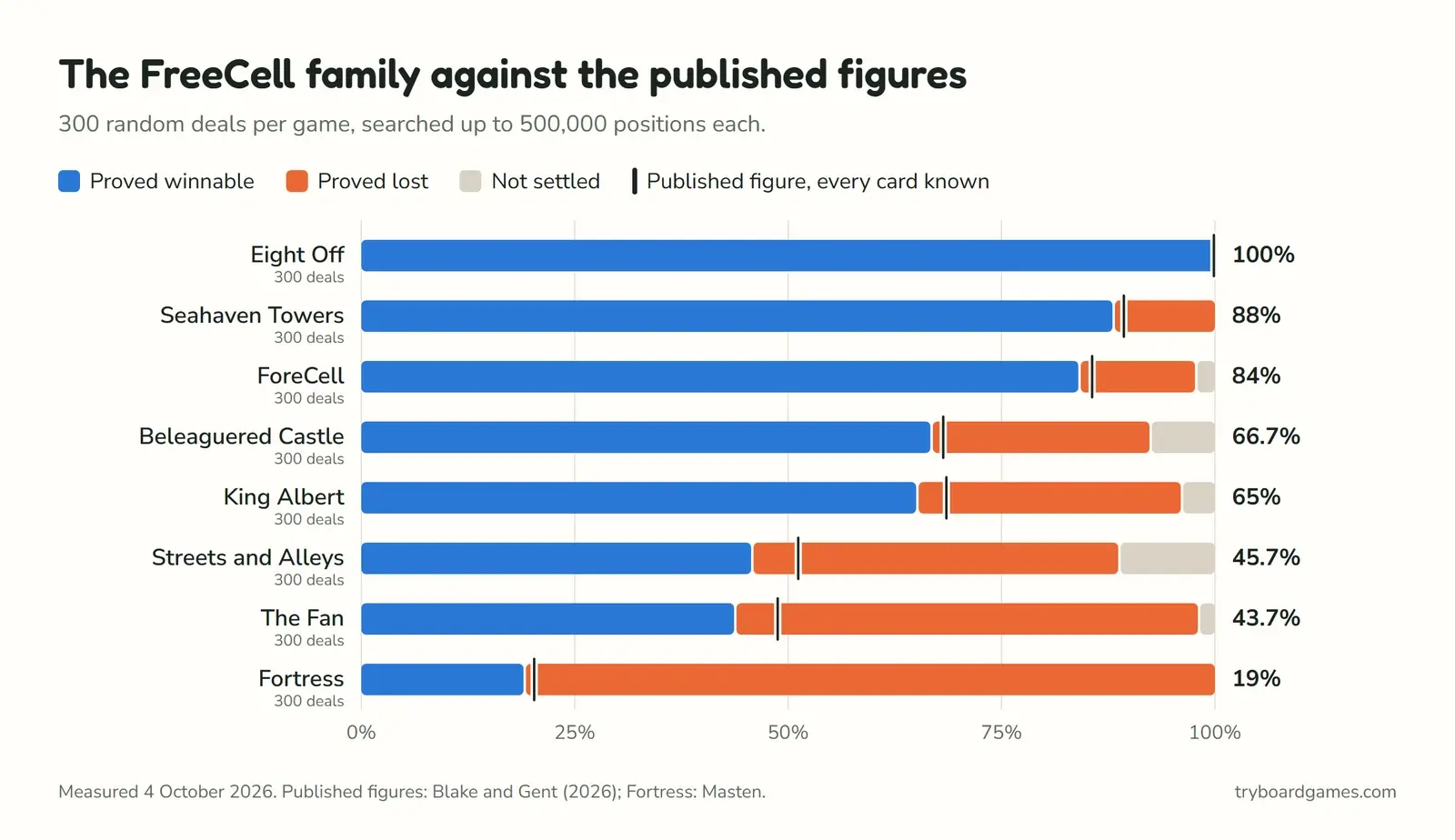
300 deals per game. Every published figure sits inside our range or within the sampling error.
- Eight Off: 300 of 300 proved winnable. Published: 99.88%.
- Seahaven Towers: 264 winnable, 36 proved lost. Published: 89.33%.
- ForeCell: 252 winnable, 41 lost, 7 not settled. Published: 85.62%.
- Beleaguered Castle: 200 winnable, 77 lost, 23 not settled. Published: 68.17%.
- King Albert: 195 winnable, 93 lost, 12 not settled. Published: 68.54%.
- Streets and Alleys: 137 winnable, 129 lost, 34 not settled. Published: 51.19%.
- The Fan: 131 winnable, 163 lost, 6 not settled. Published: 48.78%.
- Fortress: 57 winnable, 243 proved lost. Published: 20.25%.
Numbers you see online that do not hold up
- "79% of Klondike games are winnable." We could not trace this to any study. The measured figure is 81.9% for draw three and 90.5% for draw one, both with every card known.
- "Draw one: about 80% winnable." This pairs the draw-three figure with draw one. Draw one is the easier game.
- "Four-suit Spider: 7%" (or 8%, 33%, 35%). None of them comes with a source or a method. They look like win rates of players, or of one app's players, presented as if they were the share of winnable deals. With every card known, research puts four-suit Spider near 98.5%.
- "Pyramid: about 5%." No source given. The figure depends heavily on how many passes the rules allow, from 22.8% with one pass to 83.2% with unlimited passes.
What this means when you play
A lost deal is not always your fault. In Baker's Game, about one deal in four cannot be won however you play it. In Klondike you also lose deals that were winnable, because the cards you needed were face down.
If you only want deals that can be won, turn on Winnable in the deal menu next to New deal. You then only get boards the solver has already proved can be won. It is available in FreeCell, Baker's Game, Klondike, Spider, Yukon, Pyramid, Canfield, Forty Thieves and most of their relatives.
 The Winnable switch in the deal menu.
When you are stuck, the Hint button asks the same solver for the next move of a winning line from your current position. If it cannot find one within its budget, it suggests the most promising move instead.
Sources
- Charlie Blake and Ian P. Gent, The Winnability of Klondike Solitaire and Many Other Patience Games, Journal of Artificial Intelligence Research 85 (2026).
- Shlomi Fish, Solvability of the FreeCell Pro deals (2016, updated 2018).
- Ronald Bjarnason, Alan Fern and Prasad Tadepalli, Lower Bounding Klondike Solitaire with Monte-Carlo Planning, ICAPS 2009.
- Xiang Yan, Persi Diaconis, Paat Rusmevichientong and Benjamin Van Roy, Solitaire: Man Versus Machine, NIPS 2004.
- Mark Masten, Pyramid win rates, solitairewinrates.com.
- Alex Robinson, plspider, results for numbered Spider deals.