Blackjack House Edge: 7 Tables Tested on 386 Million Hands
The house edge on our seven blackjack tables runs from 0.30% to 0.75% of each starting bet, if every hand is played the best way for that table's rules. Single Deck has the lowest edge on a freshly shuffled deck, but we deal it down to a cut card, and dealt that way it costs 0.42%, about the same as Classic. Spanish 21 keeps the most. How you play matters far more than which table you sit at: copying the dealer's rules cost 5.6% on Classic Blackjack, and never hitting a hand that could bust cost 6.0%.
We worked these figures out twice. A combinatorial analyzer written for this article calculates the edge exactly from the rules. Then the site's own Blackjack code played 386 million simulated rounds, dealt the way the page deals them. Below are the results, how we got them, and what they mean at the table.
Which blackjack table has the lowest house edge
House edge with the best play for each table, from a fresh shoe and as dealt here:
- Single Deck: 0.30% from a fresh deck, 0.42% as dealt here. One deck, dealer hits soft 17, doubles on 9 to 11 only, one split.
- Vegas Strip: 0.35% fresh, 0.39% as dealt. Four decks, dealer stands on soft 17.
- Atlantic City: 0.35% fresh, 0.38% as dealt. Eight decks, late surrender.
- Double Deck: 0.38% fresh, 0.44% as dealt. Two decks, dealer hits soft 17, double on any two cards.
- Classic: 0.40% fresh, 0.41% as dealt. Six decks, dealer stands on soft 17.
- European: 0.56% fresh, 0.58% as dealt. Two decks, no hole card, doubles on 9 to 11 only.
- Spanish 21: 0.75% fresh, 0.74% as dealt. Six decks with the tens removed, bonus payouts for some 21s.
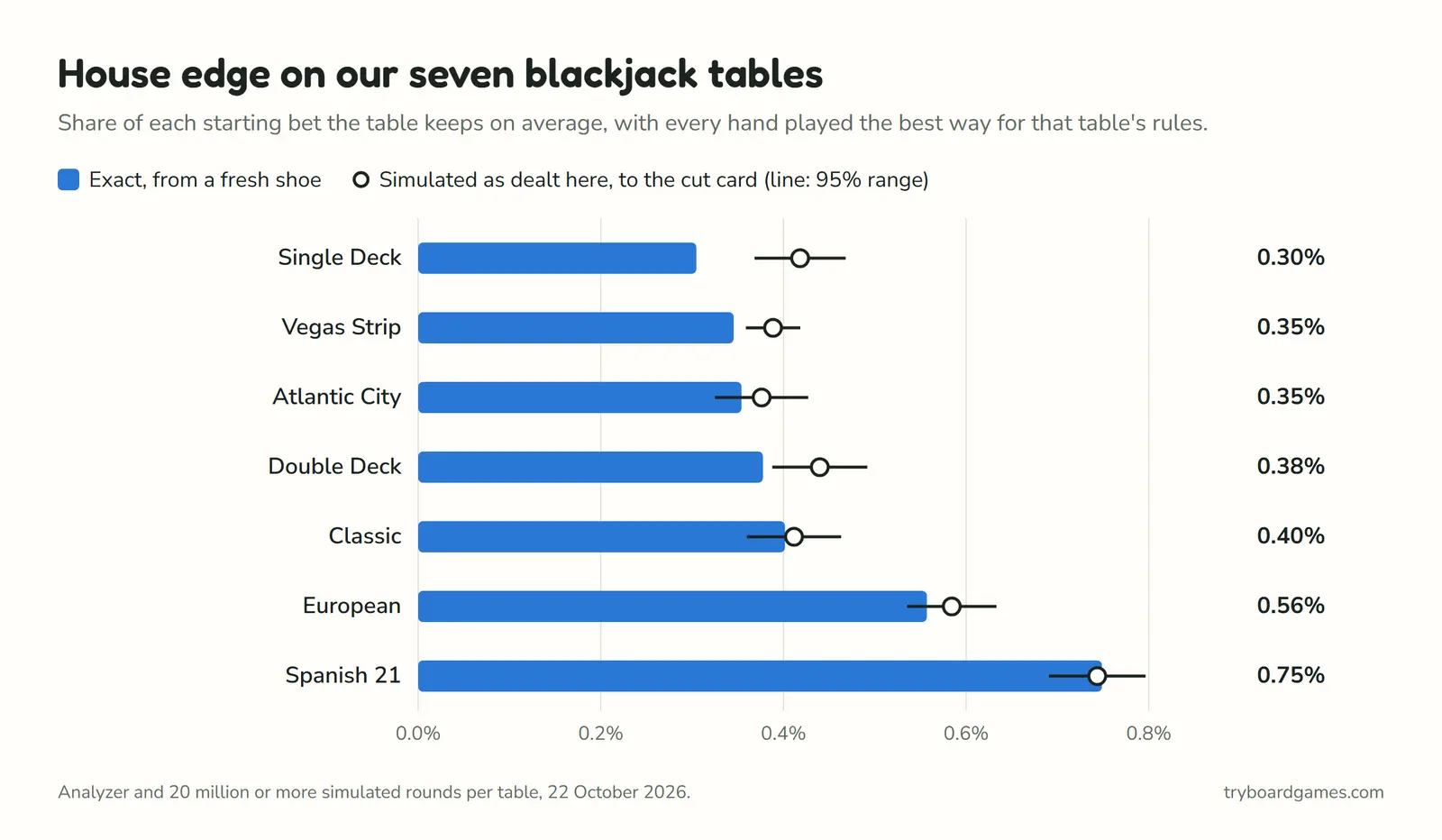
Bars are exact from a fresh shoe; circles are the simulation dealt to the cut card, the way the tables here deal.
The simulated figures carry a margin of about 0.05 points either way, so tables closer together than that cannot be ranked by simulation alone. The exact figures can be. The gap between the two columns is mostly the cut card, explained below.
House edge here means the average loss as a share of the bet you place before the cards are dealt. Doubles, splits and surrenders count as part of the same round, so a round where you double and lose costs two bets.
How we measured
- Exact analysis. For every up card and every pair of first cards, the analyzer works out the value of standing, hitting, doubling, splitting and surrendering, drawing each later card from the shoe with the cards already seen removed. It chooses the best play for the exact cards in the hand, which is what we mean by best play. Splits use the usual counting method for resplits, and the suits in Spanish 21's suited bonuses are worked out from the number of decks.
- Simulation. The site's own Blackjack engine, the code that runs every table, played 20 million rounds per table at a bet of 5 chips, plus a further 40 million at Vegas Strip as a repeat run. It reshuffled exactly where the page does: after three quarters of the shoe, or sooner on the small shoes, so that the last round can never run out of cards. Single Deck reshuffles after 30 cards. The best play came from the analyzer, and insurance was always declined.
- A second simulation dealt every round from a fresh shuffle instead, 10 million rounds per table. It should match the exact figures, and it did on all seven tables within its margin of error.
- Checks. Every settled round was scored a second time by separate code written from the rules: each hand's result, every bonus, the chips paid, and whether the dealer stopped drawing at the right total. In 386 million rounds the engine and the check disagreed 0 times. Every new shoe was checked to hold exactly the right cards.
- Outside check. For the six tables with standard decks, the house edge calculator at Wizard of Odds gives the same exact figures to within 0.01 points. For Spanish 21 it publishes 0.76% before the 7-7-7 super bonus for these rules; our analyzer gives 0.78%.
All runs were made on 22 October 2026.
Which rules move the house edge
To see what each rule is worth, we started from Classic, with six decks and the dealer standing on soft 17, and changed one rule at a time. Classic itself is 0.40%.
- Fewer decks help the player. One deck lowers the edge by 0.59 points, two decks by 0.23, four decks by 0.06. Eight decks raise it by 0.03.
- Dealer hits soft 17: 0.21 points worse for you.
- No double after a split: 0.14 points worse.
- Double only on 9, 10 or 11: 0.10 points worse.
- Only one split: 0.05 points worse.
- No hole card, where a dealer blackjack found at the end also takes your doubles and splits: 0.11 points worse.
- Late surrender: 0.07 points better.
- Blackjack paid 6 to 5 instead of 3 to 2: 1.36 points worse. None of our tables does this, but many casinos do, and it costs more than every other rule here put together.
This explains the order of the tables. Vegas Strip is Classic with four decks instead of six, and the edge falls by almost exactly the four-deck figure. Atlantic City gives back a little with eight decks and gains more from surrender. Single Deck starts with the large one-deck advantage and then loses most of it to the dealer hitting soft 17, doubles on 9 to 11 only, no double after a split and a single split. European has two decks in its favour and three restrictions against it, one of them the missing hole card.
Single Deck and the cut card
From a freshly shuffled deck, Single Deck is our best table at 0.30%. But no table here, and almost no casino, shuffles after every round. Our Single Deck is dealt until 30 of its 52 cards are gone, and played that way the simulation measured 0.42%. With every round dealt from a fresh deck, the same simulation gave 0.34%.
This is known as the cut card effect, and it is largest with one deck, where every card dealt changes the rest of the deck the most. The Wizard of Odds calculator shows the same gap for these rules: 0.31% when the deck is shuffled after every round, and 0.47% for a player using a basic strategy chart with a cut card. With six or eight decks the effect is small. Classic gave 0.41% as dealt against 0.40% exact.
Spanish 21 vs blackjack
A Spanish 21 deck has 48 cards, because the four tens are taken out; jacks, queens and kings stay. Played with Classic's rules, that deck alone would raise the house edge from 0.40% to 2.30%. Fewer ten-value cards means fewer blackjacks for you, fewer good doubles and fewer dealer busts.
Spanish 21's own rules give most of that back. Removing each one from our Spanish 21 table, one at a time, shows what it is worth:
- Your 21 always wins, and your blackjack beats a dealer blackjack: 1.08 points.
- Bonus payouts for five-card and longer 21s and for 6-7-8 and 7-7-7: 0.38 points.
- Hitting and resplitting aces after a split: 0.35 points.
- Doubling on any number of cards: 0.17 points.
- Rescue, giving up a doubled hand for half the doubled bet: 0.03 points.
- Surrender: 0.02 points.
Against that, the dealer hits soft 17, which costs 0.41 points. The result is 0.75%, the highest of our seven tables but well under the 2.30% the deck alone would cost.
The 7-7-7 super bonus pays 1,000 chips on a bet under 25 and 5,000 chips from 25 up, when the three sevens are suited, the dealer shows a 7, and the hand was not split. At our default bet of 5 chips that is 200 times the bet. It lowers the edge by only 0.03 points, but it changes one play. Holding two sevens of the same suit against a dealer 7, hit rather than split at any bet up to about 340 chips: one more seven of that suit pays at least 14 times the bet. With two sevens of different suits the bonus cannot happen, and splitting is right.
Spanish 21 also plays differently from the other tables. A hard 12 is always hit, a 9 is doubled only against a 6, and hard 16 and 17 are surrendered against an ace. Using the Classic chart at the Spanish 21 table raises the edge from 0.75% to 1.79%, more than double.
What common ways of playing cost
We played every table with four habits that come up whenever people talk about blackjack strategy, 4 million rounds each. Two more we worked out exactly.
- Mimic the dealer (draw to 17 by the table's dealer rule, never double, split or surrender): 5.6% on Classic, between 5.7% and 5.9% on the other standard tables. Its cost comes from the order of play: when you and the dealer would both bust, you bust first and lose, even though the dealer would have gone over too.
- Never risk a bust (stand on any hard 12 or more, hit soft 17 or less, never double or split): 6.0% on Classic and 9.6% at Spanish 21. The dealer busts less often there (see the chart further down), so a weak total left standing loses more.
- Never double or split, otherwise playing every hand the best way: 2.4% on Classic. Doubling and splitting are worth about 2.0 points.
- Always take insurance, otherwise playing the best way: 0.69% on Classic. Each insurance bet loses 7.4% of its stake on average, and 24.7% at Spanish 21, where the dealer under an ace is a ten less often.
- The Classic chart at another table: almost no cost at Vegas Strip or Double Deck, 0.04 points at Single Deck, 0.07 at European, 0.08 at Atlantic City (the Classic chart has no surrender) and 1.04 at Spanish 21.
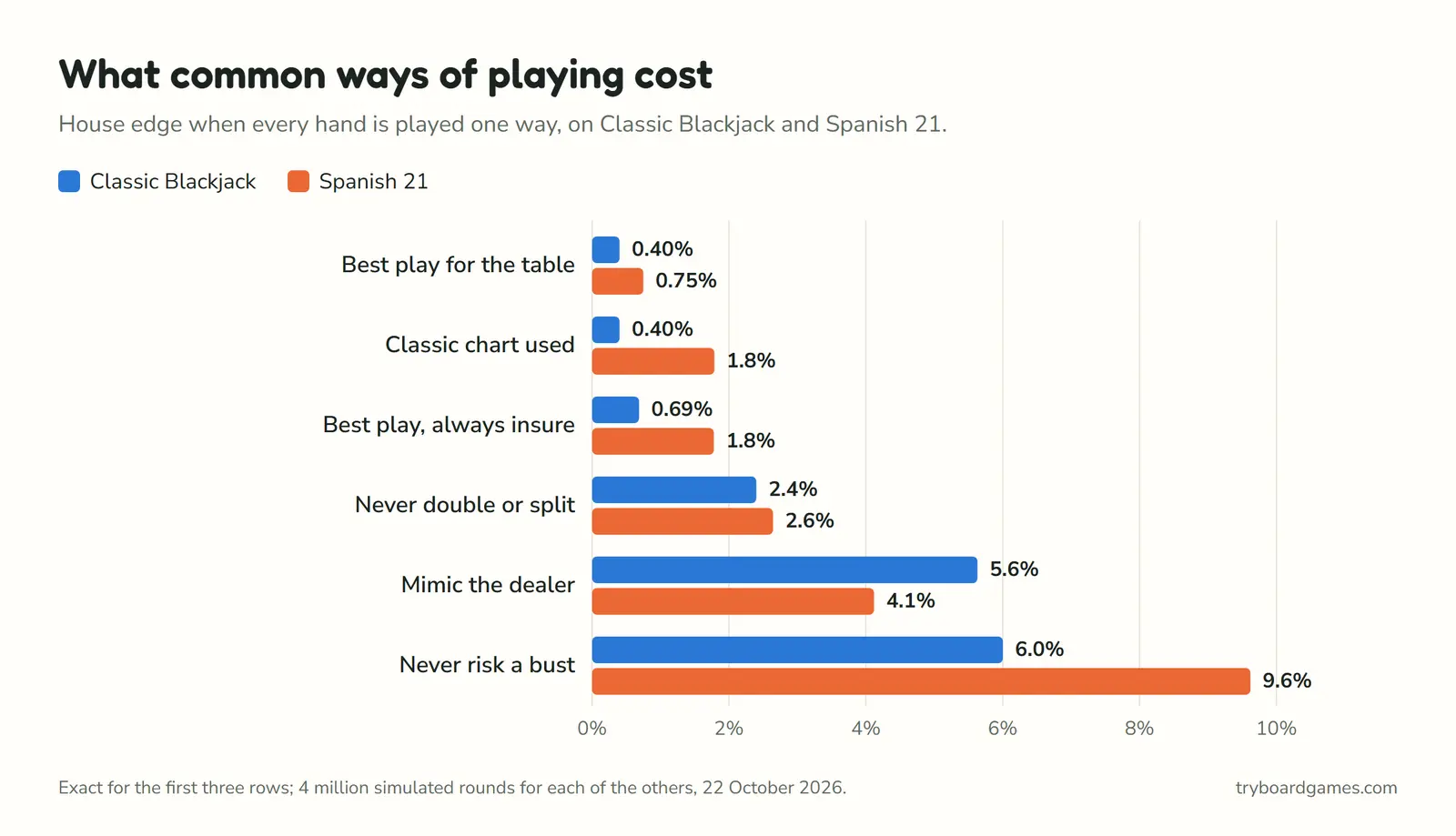
Never doubling or splitting, mimicking the dealer and never risking a bust each cost more than the whole gap between our best and worst table.
Mimicking the dealer did better at Spanish 21, 4.1%, than at our other tables. Drawing to 17 makes more 21s, and at Spanish 21 every 21 wins and the longer ones pay bonuses. Published estimates for mimicking the dealer and for never risking a bust are usually about 6%, with the exact figure depending on the rules; ours are measured on the tables named.
How often you win a hand
On Classic with the best play, you win 43.4% of rounds, push 8.7% and lose 47.9%. You lose more rounds than you win, and the edge is still small, because your wins pay more: a blackjack pays 3 to 2 and comes in 4.5% of rounds, and doubles and splits put more money down when the odds favour you. You double in 10.4% of rounds and split in 2.8%.
The dealer's up card decides most of your choices, because it decides how often the dealer busts. On Classic the dealer goes over 21 42% of the time with a 6 showing and 17% with an ace, counted over the hands where it has no blackjack. That is why the best play stands on 13 to 16 against a 2 to 6 and hits them against a 7 or higher.
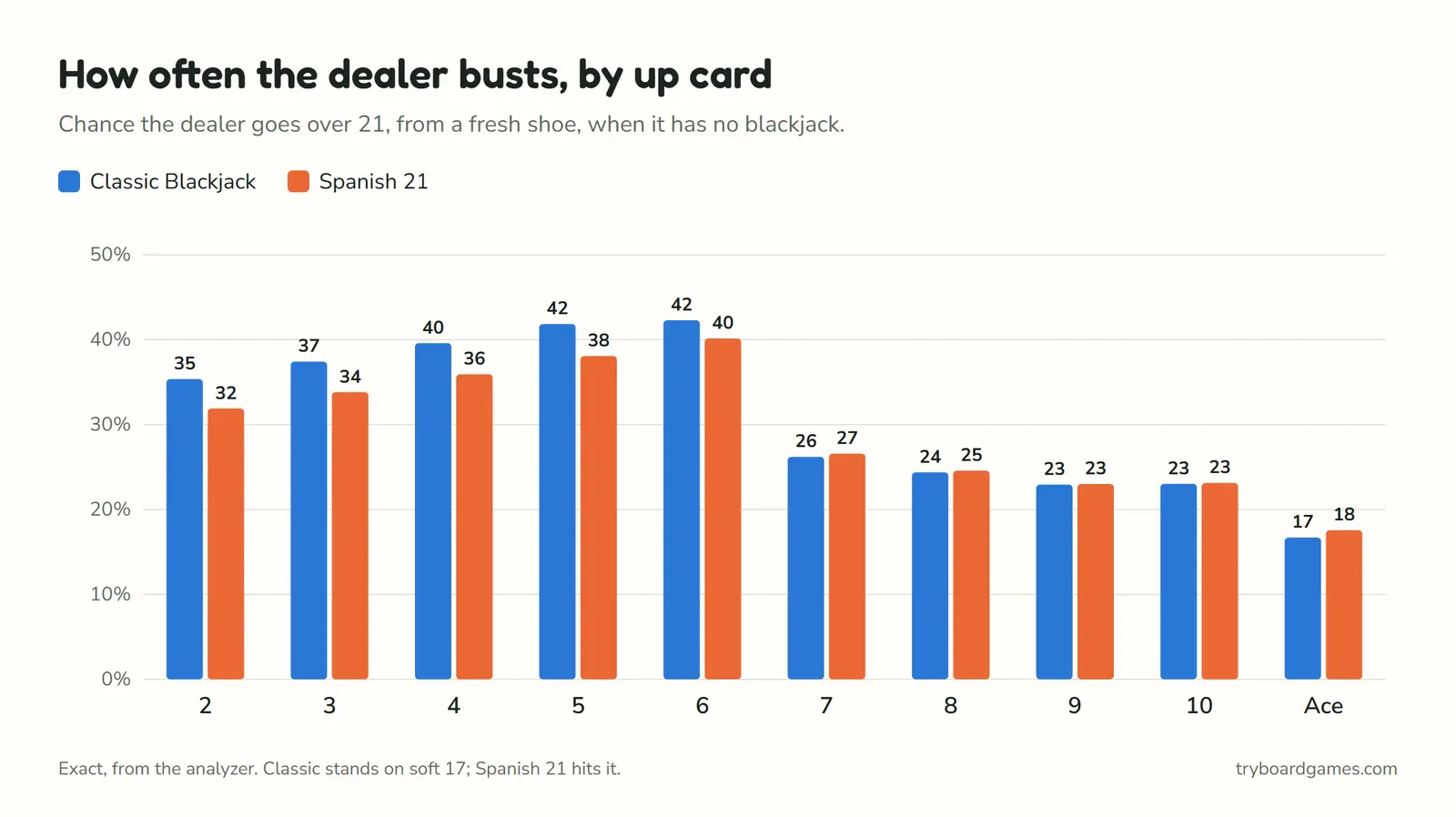
With a 2 to 6 showing the dealer busts far more often than with a 7 or higher. Spanish 21's missing tens lower the small-card figures.
What this means at the table
- Learn the best play for the table you are at. That is worth more than any choice of table: the gap between our best and worst table is under half a point, and the gap between the best play and mimicking the dealer is over five points.
- If you play from one chart, play it at Classic, Vegas Strip or Double Deck, where the six-deck chart costs almost nothing. At Spanish 21 learn its own chart.
- Decline insurance. It loses about 7% of what you put on it at our standard tables and about a quarter at Spanish 21.
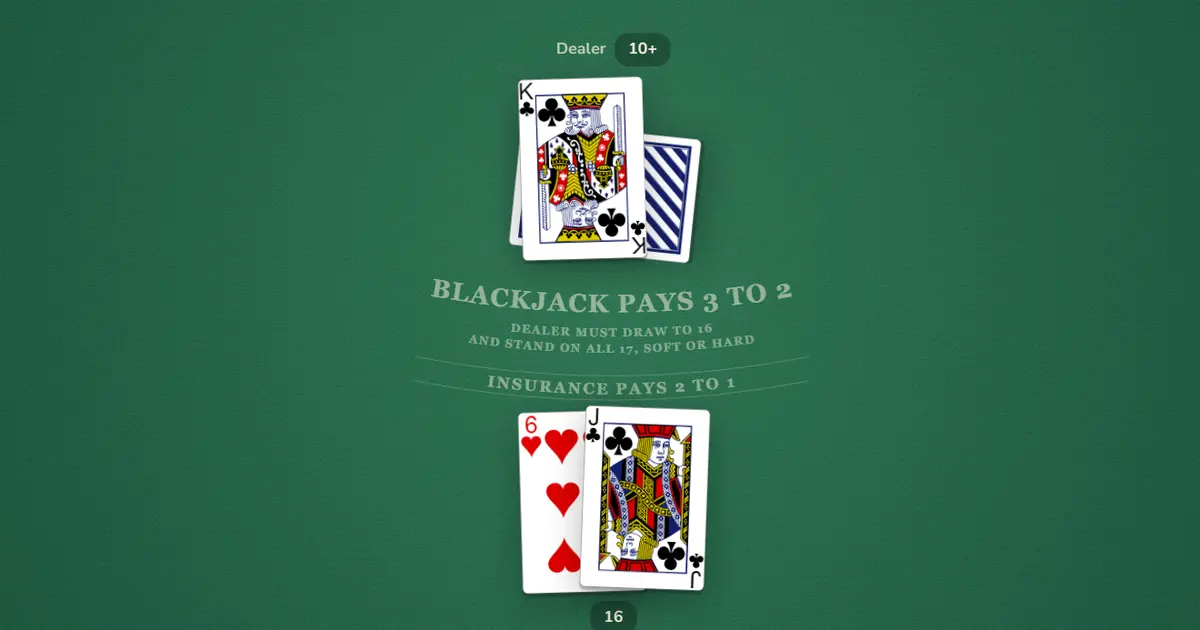
- At Atlantic City, surrender hard 16 against a 9, 10 or ace and hard 15 against a 10, as in the hand below.
- Expect your chips to swing far more than the edge. At 5 chips a round, 100 rounds of Classic lose about 2 chips on average, but the usual spread after 100 rounds is about 60 chips either way.
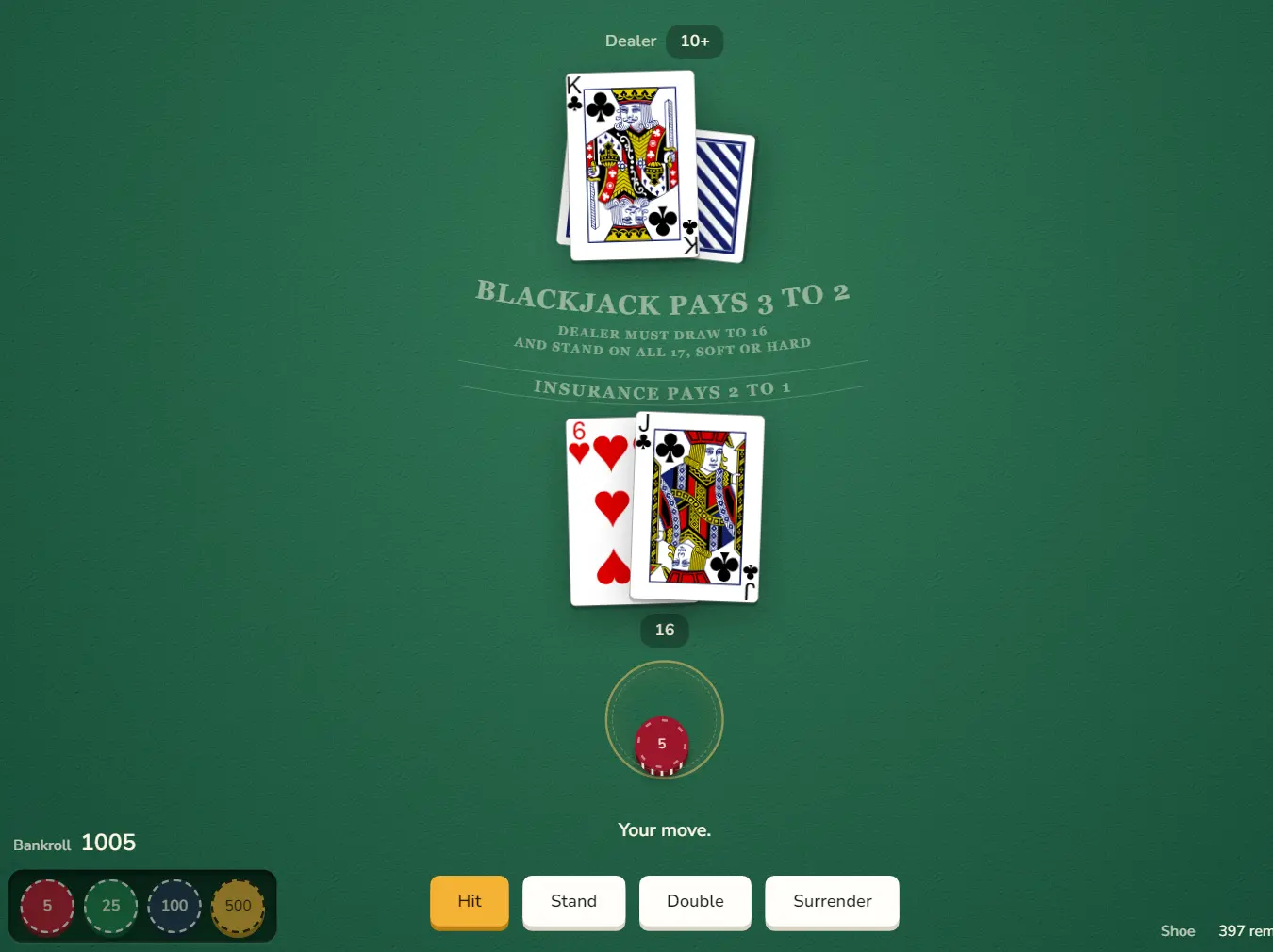
Hard 16 against a dealer 10 at Atlantic City. Surrender is the best play here: it keeps half the bet, and playing on loses more than that on average.
What the numbers leave out
- Our best play reads the exact cards in your hand. A printed chart uses only the total, which is slightly worse: by about 0.04 points at one deck and less with more decks, according to Wizard of Odds.
- No card counting. Every decision uses only the cards in the current round, as most players do.
- Our rules. Tables with the same names elsewhere often have different rules. The rule figures above show how much a change is worth.
- Virtual chips. Every table here is free and plays for chips with no cash value.
Earlier in this series our solvers tested 10,600 solitaire deals in Can Every Solitaire Game Be Won?
Sources
- Wizard of Odds, Blackjack House Edge Calculator, figures read 22 October 2026 for each of our six standard rule sets.
- Wizard of Odds, Spanish 21, house edge by rule set and the effect of the super bonus.
- Cornell University, Mathematics Explorers' Club, Blackjack, on mimicking the dealer and never risking a bust.