Mahjong Solitaire Strategy, Tested on 170,000 Deals
The Mahjong solitaire tip that helps most is to take the pair that frees the most tiles. On the classic Turtle layout it won 9.1% of random deals in our test, against 5.6% for taking any matching pair at random. Two of the most repeated tips did worse than random: working from the top down won 3.2% and clearing the longest rows first won 4.8%. The best combination of rules won 14.4%, about two and a half times as often as random play.
Every Mahjong board on this site has a solver behind its Hint button. For this article we used it, together with nine simple ways of choosing a pair, on 170,000 freshly shuffled deals across our 17 layouts. The rules only use what a player can see. Below are the results, how we measured them, and what they mean when you play.
The short answer
Each rule played 10,000 random Turtle deals on its own, from the first pair to the last, with no undo. Share of deals cleared:
- All the rules that help, in order: 14.4%. Safe pairs first, then the pair that frees the most tiles, then the highest pair, then the pair in the longest row.
- Free the most tiles, then take the highest pair: 11.1%.
- Free the most tiles: 9.1%.
- Skip pairs that free nothing: 6.6%.
- Take all four when all four are free: 5.9%.
- Any matching pair at random: 5.6%. This is the baseline.
- Safe pairs first: 4.9%.
- Clear the longest rows first: 4.8%.
- Work from the top down: 3.2%.
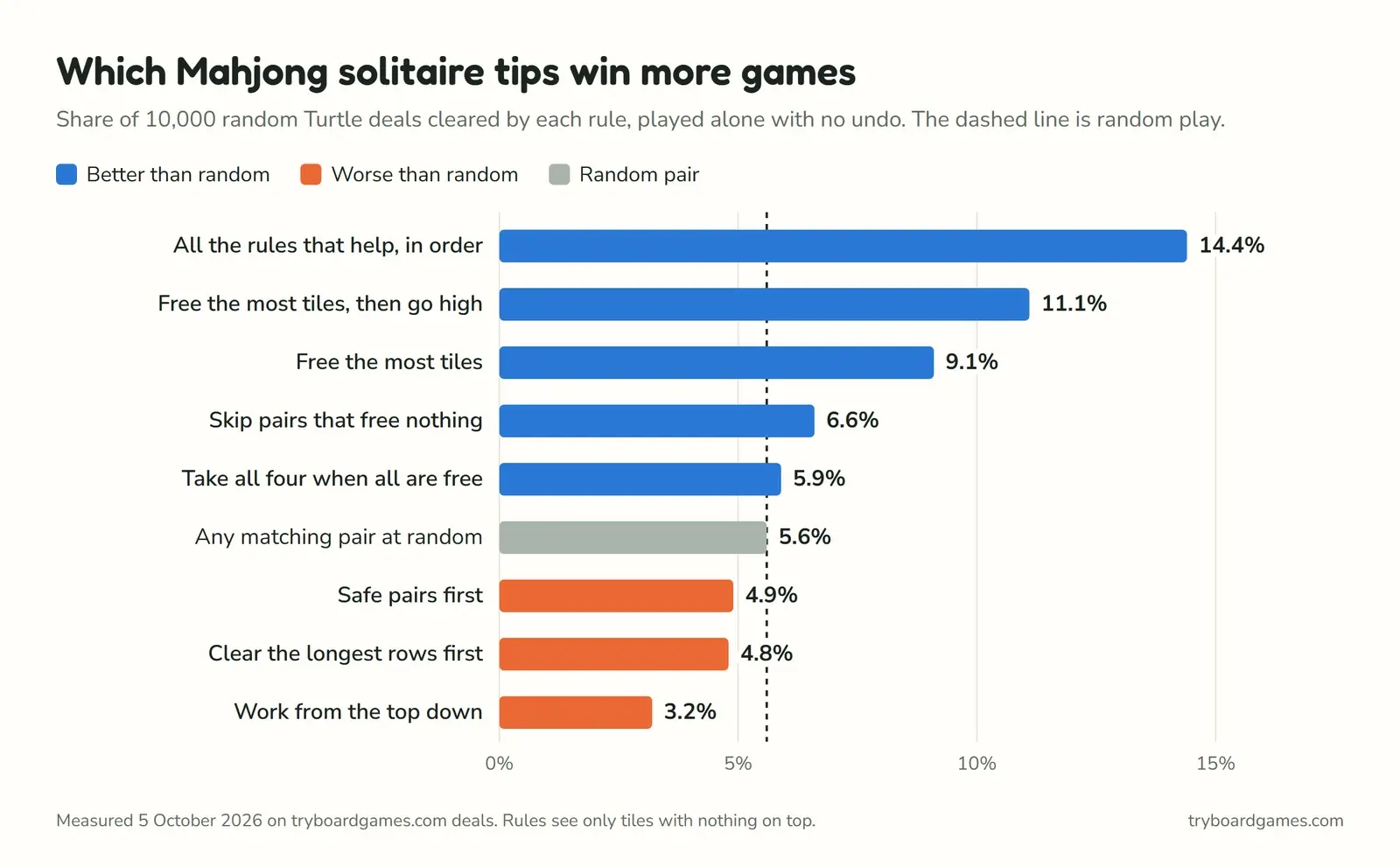
Each rule played every deal on its own, with no undo. Orange bars did worse than picking pairs at random.
The other finding is that most lost games could have been won. Of the 1,000 Turtle deals we also gave to the solver, the combined rule lost 846. At least 733 of those could have been cleared by someone who knew where every tile was.
How we tested
- Deals. Each deal is a seeded random shuffle, made the same way the game deals a new board when Winnable is off. We used 10,000 deals for each of the 17 layouts, 170,000 in all, and every rule played every deal.
- What the rules can see. A tile counts as visible when nothing rests on it. A rule chooses only among the pairs a player could take, and it may use the shape of the board, the faces of free tiles and the tiles already removed. It never reads a face hidden under another tile. When a rule rates two pairs the same, it picks one at random, from a fixed seed, so every run can be repeated exactly.
- No undo and no hints. Each game ran until no matching pair was free, and counted as cleared only when no tile was left.
- Tiles. The full set is 144 tiles: 34 faces four times each, plus four flowers and four seasons. Any flower matches any flower and any season matches any season. Layouts with fewer than 144 places take a random selection of pairs, so on those some faces appear only twice.
- Solver. The solver behind the Hint button sees every face, including covered ones. It searched 1,000 deals per layout, first up to 1 million positions each, then the deals it had not settled again up to 5 million. A deal counts as impossible only when the search tried every position the deal can reach. A deal that ran out of search is reported as not settled, never as lost.
- Checking. Every winning line the solver found was replayed pair by pair through the game's own rules and had to end on an empty board. For 130 deals on four layouts, a second solver written separately for this article gave the same verdict on every deal both of them settled.
All runs were made on 5 October 2026.
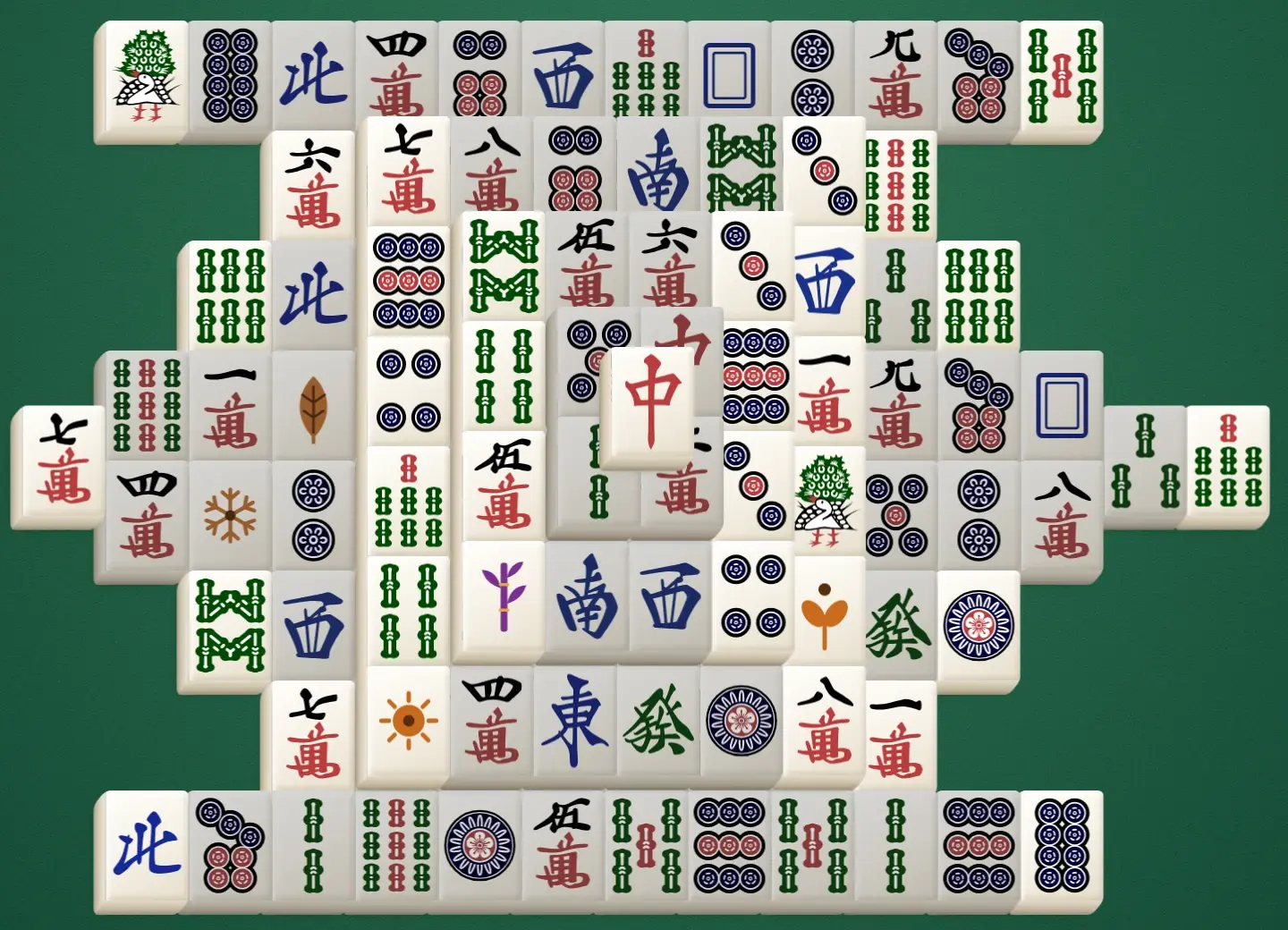
87 of the Turtle's 144 tiles lie on the bottom layer, most of them in rows that only open from the ends.
The tips, one by one
Free the most tiles: the one that works
Before you take a pair, count the tiles it would free: the tiles it is lying on, and the tile beside it at the end of a row. Take the pair that frees the most. You can see all of this before you choose, because it depends only on where the tiles are, not on what the covered ones show.
On its own, this rule won 9.1% of Turtle deals and left 41.5 tiles on the board on average, against 54.5 for random play. It was the best single rule on 8 of the 15 layouts where any rule won a game. The game only ends when no free pair is left, and every newly freed tile is another chance of a match.
Work from the top down: worse than random on the Turtle
This is the tip almost every guide gives first. On the Turtle it won only 3.2% of deals and left 64 tiles on average, the worst of the nine rules. Our reading is that the Turtle's difficulty is not its height. 87 of its 144 tiles lie on the bottom layer, most of them in long rows that only open from the ends. Taking the highest pair first spends moves on the middle stack while those rows stay blocked.
The same rule works well where height is the whole problem. On Eight Stacks, eight towers four tiles high, it won 20.0% of deals against 4.3% for random play. On Seven it won 99.5% against 71.0%. Working from the top was the best single rule on five of our layouts, among them Eight Stacks and Castle.
Clear the longest rows first: also below random
Taking pairs from the longest rows won 4.8% on the Turtle, again below random. It did help a little on The Great Wall, a flat wall where every row is long, but even there the combined rule cleared only 3.0% of deals. Row length is better used as a tie-breaker than as a rule.
Take all four at once, and other safe pairs
Some pairs can never hurt. When all four tiles of a face are free, taking them as two pairs is always safe. So is taking the last two tiles of a face once the other two are gone. Neither move can turn a board that could be cleared into one that cannot.
As rules on their own, though, they barely change the result: 5.9% for taking all four, 4.9% for taking safe pairs first. They only tell you what to do with pairs that were harmless anyway. The games are decided by the other pairs, where you have to choose.
Skip pairs that free nothing
Leaving a pair alone when it frees no tile, as long as some other pair does, won 6.6%. It is a weaker version of freeing the most tiles: it avoids the worst moves but does not look for the best one.
Putting them together
The best rule we found for the Turtle, which we call the combined rule, takes safe pairs first, then the pair that frees the most tiles, then the highest pair, then the pair in the longest row. It won 14.4% of Turtle deals and left 38.2 tiles on average. Freeing tiles does most of the work. Adding height as a tie-breaker raised it from 9.1% to 11.1%, and safe pairs plus row length added the rest.
The gain is largest on layouts with room to choose. On Hourglass the combined rule won 37.5% of deals against 8.7% for random play, and on Deep Well 34.9% against 7.9%.
With 10,000 deals per rule, differences smaller than about one percentage point are within the noise.
How this compares with earlier tests
We found one earlier test of the same tips: Adam Narkiewicz's strategy guide at mahjong-pro.com, from September 2025, which simulated random play on 10 million Turtle deals and each strategy on 1 million. Its random-play figure is 5.9%, close to our 5.6% and within our sampling error. Its best single rule, maximizing the number of available moves, won 13.7%, and its combination of rules 16.8%. Looking three moves ahead raised the combination to 21.4%, and five moves ahead to 24.1%.
Both tests rank the tips the same way: freeing tiles or moves helps most, and row-length rules help least. Our figures for the better rules are lower. The guide does not say whether its program could see covered tiles. Ours could not, and a rule that peeks at what a move will uncover has an advantage no player has.
Is every Mahjong solitaire game solvable?
No. Even with every face known, some deals cannot be cleared. The largest test we found, by de Bondt, solved 10 million Turtle deals and found 2.95% impossible. Our solver proved 887 of 1,000 Turtle deals winnable and 1 impossible; it did not settle the other 112 within 5 million positions.
The layout matters far more than the deal. Here is every layout on this site, with the share of 10,000 deals the combined rule cleared, the share random play cleared, and what the solver found on 1,000 of them:
- Seven (144 tiles, 2 layers): combined rule 99.7%, random play 71.0%. Solver: 1,000 winnable, 0 impossible, 0 not settled.
- Hourglass (102 tiles, 3 layers): combined rule 37.5%, random play 8.7%. Solver: 708 winnable, 141 impossible, 151 not settled.
- Small Portal (128 tiles, 3 layers): combined rule 36.1%, random play 25.3%. Solver: 915 winnable, 58 impossible, 27 not settled.
- Deep Well (136 tiles, 3 layers): combined rule 34.9%, random play 7.9%. Solver: 912 winnable, 33 impossible, 55 not settled.
- Eight Stacks (144 tiles, 5 layers): combined rule 22.3%, random play 4.3%. Solver: 554 winnable, 362 impossible, 84 not settled.
- Scales of Justice (68 tiles, 3 layers): combined rule 21.3%, random play 11.3%. Solver: 268 winnable, 732 impossible, 0 not settled.
- Pyramid (144 tiles, 3 layers): combined rule 19.3%, random play 10.0%. Solver: 949 winnable, 0 impossible, 51 not settled.
- Castle (144 tiles, 4 layers): combined rule 18.2%, random play 10.3%. Solver: 940 winnable, 0 impossible, 60 not settled.
- Turtle (144 tiles, 5 layers): combined rule 14.4%, random play 5.6%. Solver: 887 winnable, 1 impossible, 112 not settled.
- Butterfly (144 tiles, 3 layers): combined rule 10.1%, random play 0.4%. Solver: 534 winnable, 0 impossible, 466 not settled.
- Five Pyramids (104 tiles, 3 layers): combined rule 8.0%, random play 2.8%. Solver: 135 winnable, 865 impossible, 0 not settled.
- Seven Pyramids (144 tiles, 4 layers): combined rule 3.1%, random play 0.6%. Solver: 67 winnable, 922 impossible, 11 not settled.
- The Great Wall (108 tiles, 1 layer): combined rule 3.0%, random play 1.9%. Solver: 191 winnable, 809 impossible, 0 not settled.
- Spider (132 tiles, 3 layers): combined rule 2.6%, random play 0.6%. Solver: 577 winnable, 97 impossible, 326 not settled.
- Fortress (144 tiles, 4 layers): combined rule 0.8%, random play 0.2%. Solver: 304 winnable, 674 impossible, 22 not settled.
- Dragon (122 tiles, 4 layers): combined rule 0%, random play 0%. Solver: 0 winnable, 1,000 impossible, 0 not settled.
- Bridge (144 tiles, 4 layers): combined rule 0%, random play 0%. Solver: 0 winnable, 999 impossible, 1 not settled.
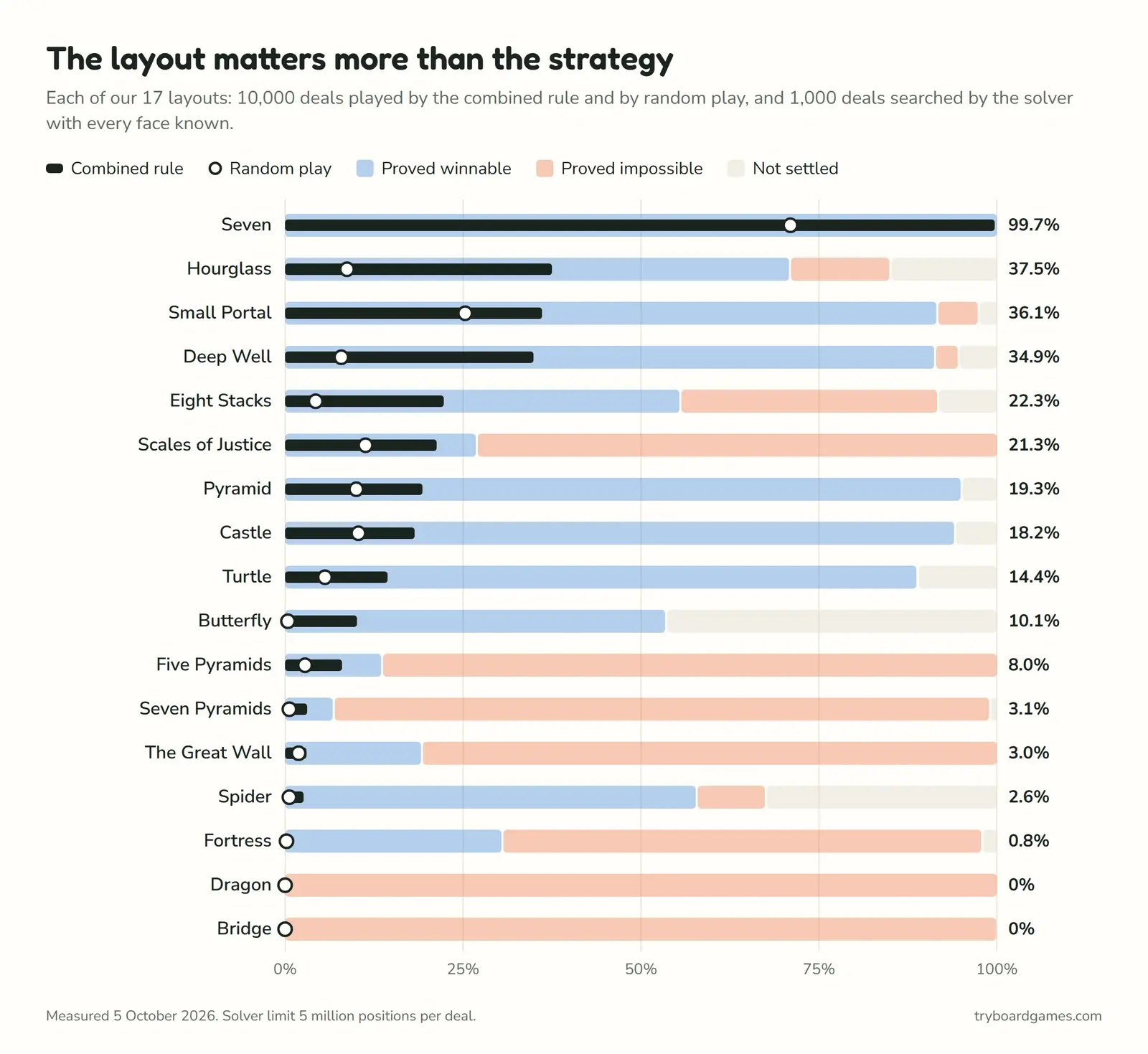
The black bar is the combined rule, the circle is random play, and the pale band behind them is what the solver found with every face known.
Seven of our 17 layouts are mostly impossible as dealt. Out of 1,000 random deals each, the solver proved 1,000 impossible on Dragon, 999 on Bridge, 922 on Seven Pyramids, 865 on Five Pyramids, 809 on The Great Wall, 732 on Scales of Justice and 674 on Fortress. The reasons we could pin down:
- Long rows. The Great Wall is one flat layer of nine rows of 12, so at the start only the 18 tiles at the row ends are free. Bridge's deck is two rows of 18 tiles with shorter rows stacked on top, so for most of the game only a few row ends are free.
- Few free tiles. Seven Pyramids starts with only 7 free tiles, against 35 on the Turtle.
- Pairs buried under themselves. Layouts with fewer than 144 places use a random selection of pairs, so some faces have only two tiles. When one of them lies on top of the other, that pair can never be taken. This happens before the first move in 38% of Scales of Justice deals, 33% of Five Pyramids deals and 19% of Dragon deals.
Layout names are not a standard. De Bondt's tests list a Bridge with 32% impossible deals and a Dragon with 7.5%, but those are different shapes from ours that happen to share the name.
If you play those layouts, turn on Winnable in the menu next to New game. With it on, every board you get has been cleared once by the game before it is dealt to you, so it can always be won.
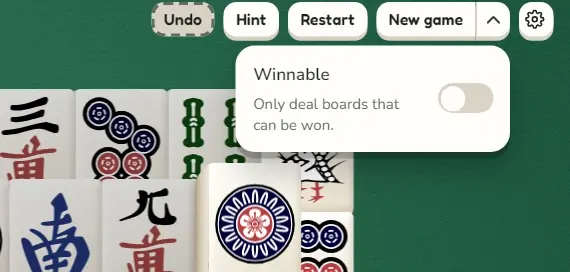
The Winnable switch in the menu next to New game.
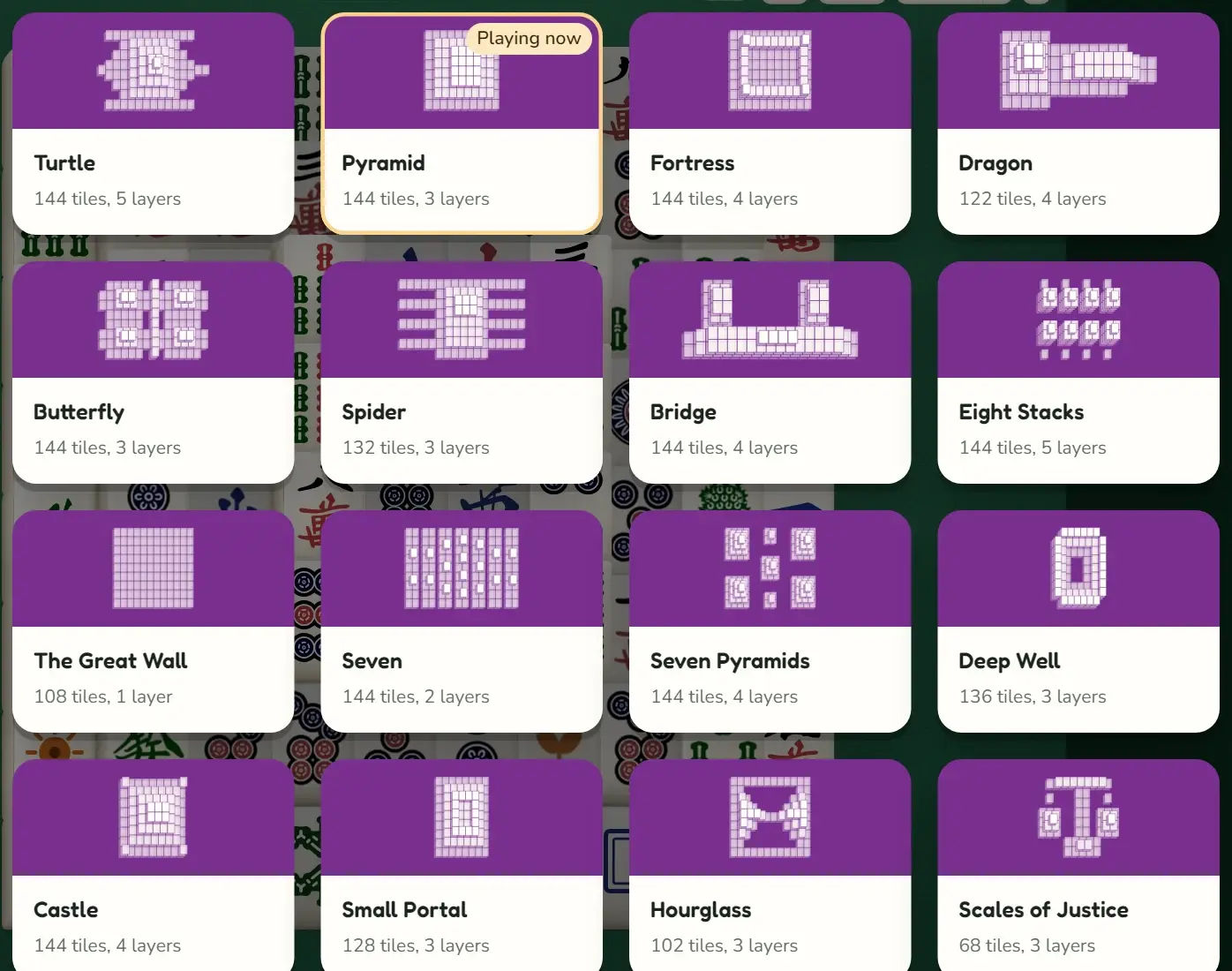
Every layout shows its tile count and its number of layers. Neither tells you how hard it is.
When you lose, was it the deal or the play?
On the Turtle, mostly the play, or rather what the play could not see. Random play lost 947 of the 1,000 deals the solver also searched, and at least 834 of those could have been cleared with every face known. Even the combined rule lost 846, and at least 733 of those were winnable. Only 1 of the 1,000 deals were proved impossible.
The gap comes from covered tiles. When three tiles of a face are free and the fourth is buried, which two you take matters: the one you leave may be the tile lying on top of the fourth. No rule that only sees the top of the board can always get that right.
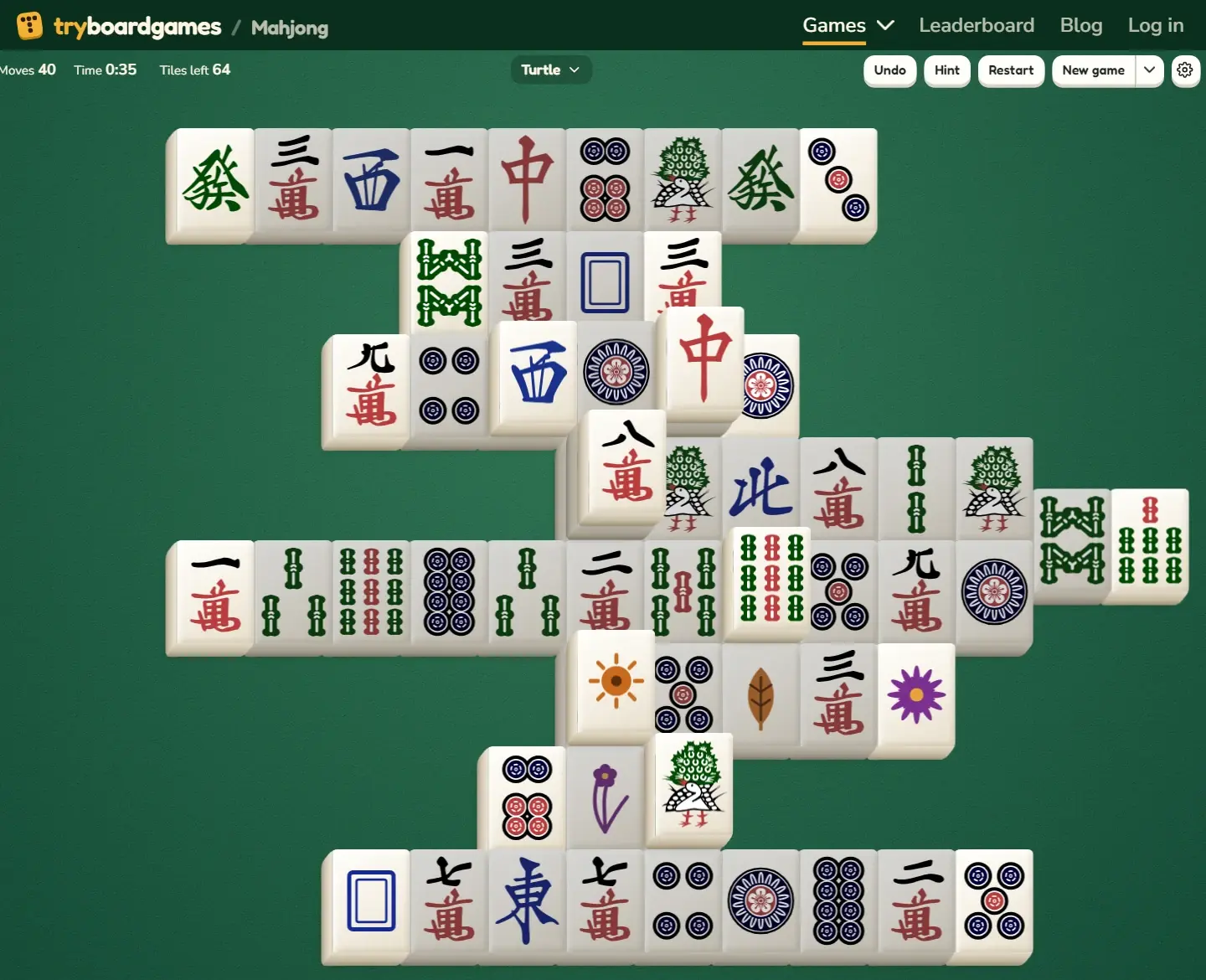
A game played top-first on the live site, stuck with 64 tiles left. Undo is the way out.
What this means when you play
- Take safe pairs when you see them: all four tiles of a face free, or the last two of a face.
- Otherwise take the pair that frees the most tiles. Count the tiles each pair is lying on and the tiles next to it at the end of a row.
- If two pairs free the same number, take the higher one, then the one in the longer row.
- With three tiles of a face free, keep the one that is not lying on anything you need.
- On the Turtle, do not play top-first or longest-row-first as a habit. On tall layouts like Eight Stacks, height does matter.
- Use Undo. None of the figures above did, and going back a few pairs to try the other choice is the easiest way to beat them.
When you are stuck, the Hint button asks the solver for the next pair of a winning line from your current position. If it cannot find one within its search budget, it suggests the pair that frees the most tiles instead.
What the numbers leave out
- People do better than fixed rules. A player remembers, plans a few pairs ahead and uses Undo. Our rules do none of that, so read the figures as a comparison between tips, not as how often you will win.
- Half-covered tiles. On the screen you can often see part of a tile that is half covered. Our rules treat every covered tile as unseen.
- Our layouts and our deals. Other sites use other shapes under the same names, and may deal smaller layouts differently.
For a similar test on card games, see Can Every Solitaire Game Be Won?, where our solvers played 10,600 deals of 19 solitaire games.
Sources
- de Bondt, Solitaire Mahjongg solver, Radboud University Nijmegen. Results for 10,000,000 Turtle deals and 100,000 deals of other layouts.
- Adam Narkiewicz, Mahjong Solitaire Strategy Guide, mahjong-pro.com, 6 September 2025. Simulated win rates for random play and five strategies on the Turtle.
- Jan N. van Rijn, Playing Games: The complexity of Klondike, Mahjong, Nonograms and Animal Chess, master's thesis, Leiden University, 2012. Proves that deciding whether a Mahjong solitaire deal can be cleared is NP-complete.