How to Win at Ludo: Strategy Tested on 3 Million Games
Тази публикация още не е преведена, затова се показва на английски.
The Ludo tip that helps most is also the easiest to check: before you move, look at the six squares behind where your token will land. If an opponent's token is sitting there, pick a different move. In our test, a player who followed only that rule won 43.5% of four-player games against three opponents moving at random, where a fair share is 25%. Four popular tips did worse than random. The worst were bringing a new token out on every six, which won 12.6%, and always moving the token at the back, which won 3.5%. All the rules that help, combined, won 64.5% of games, more than two and a half times a fair share.
For this article we wrote a Ludo simulator that uses the same rules as our Ludo game, gave it 17 different ways of choosing a move, and let it play 3.15 million games. Below are the results, how we ran them, and what the same games say about three questions people ask about Ludo: whether going first helps, how long a game takes, and whether Ludo is luck or skill.
Ludo tips ranked by win rate
Each tip played 50,000 four-player games against three opponents who pick any legal move at random. Share of games won:
- All the tips that help, combined: 64.5%. The order of checks is under "Putting them together" below.
- Don't stop just ahead of an opponent: 43.5%.
- Move the token that is in danger: 36.5%.
- Race one token home at a time: 33.4%.
- Capture whenever you can: 31.5%.
- Any legal move at random: 25.2%. This is the baseline.
- Stop on safe squares: 23.9%.
- Double up your tokens: 22.2%.
- Bring a token out on every six: 12.6%.
- Move the token at the back: 3.5%.
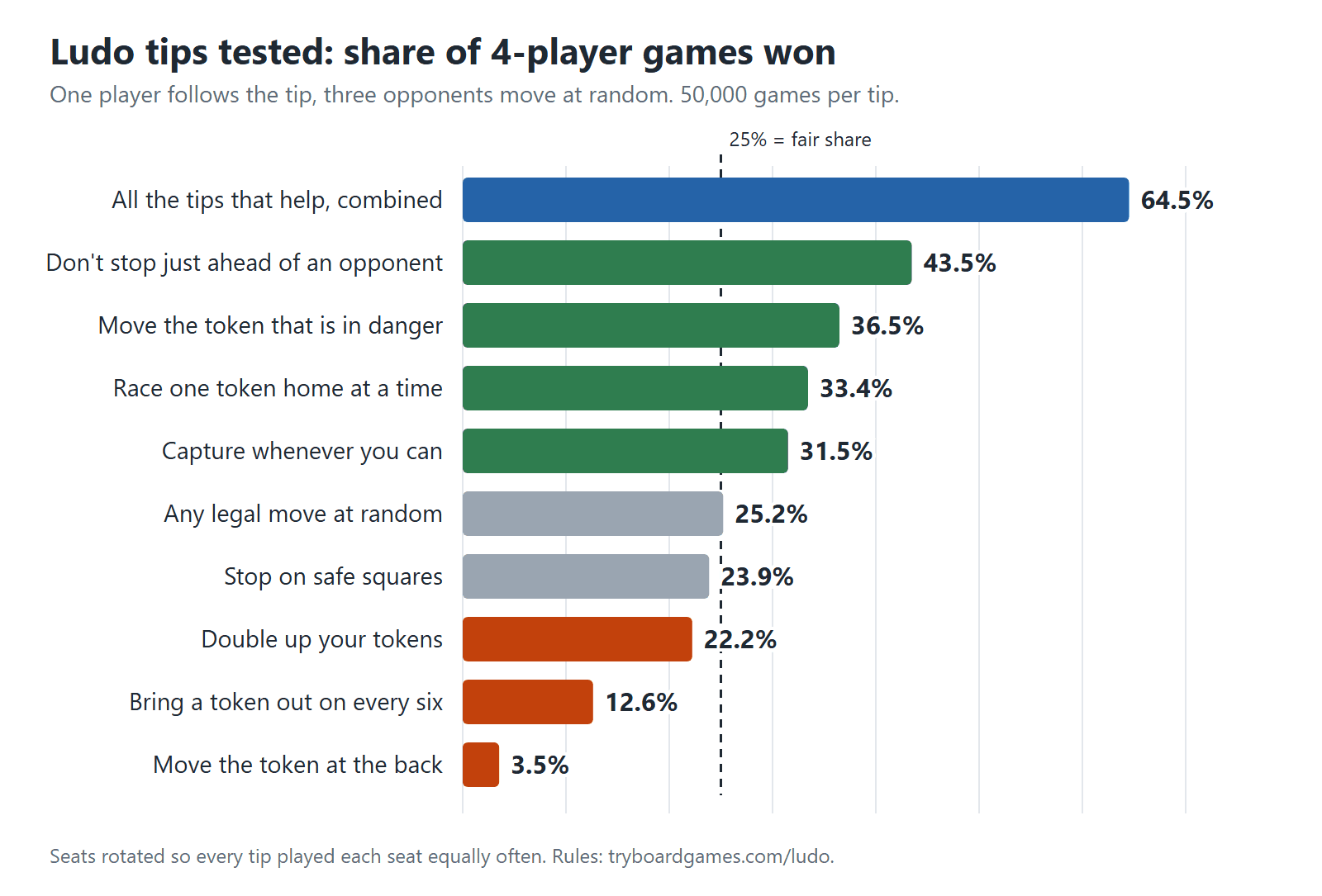
A fair share in a four-player game is 25%. With 50,000 games per tip, each figure is accurate to within about 0.4 percentage points.
How we tested
- The rules are the ones on our board. One die. A token leaves the yard only on a six. A six gives another roll, and a third six in a row is void and ends the turn. The track has 52 squares, then each player has a five-square home column, and a token needs the exact number to reach home. Landing on an opponent sends their token back to the yard, unless the square is one of the eight safe squares: the four start squares and the four stars. Capturing and reaching home give no extra roll. There are no blocks, so two of your tokens on one square can both be captured. You have to move if you can.
- Each tip is a way of choosing between legal moves. When a roll allows only one move, every tip plays it. When the tip has no preference, it picks at random. Each tip only uses what a player can see on the board.
- Two kinds of opponents. The main test uses three opponents who pick any legal move at random. We then repeated it against three careful opponents, each playing the combined strategy described below.
- Seats are rotated. The player using the tip sat in each of the four seats equally often, so going first or last does not favor any tip.
- Two-player games put the players in opposite corners.
- Volume. 50,000 games for each tip and line-up, plus 500,000 games for the baseline figures on turn order and game length: 3.15 million games in all, run on October 13, 2026. Every game is seeded, so the same run gives the same numbers.
The tips, one by one
Don't stop just ahead of an opponent: the best single tip
A token is in danger when an opponent's token sits one to six squares behind it, on a square that is not safe, and that opponent's path still passes over it. The rule picks the move whose landing square has the fewest opponents behind it. It also gives a little weight to opponents seven to twelve squares back, who would need a six first and then the right number.
On its own this rule won 43.5% of four-player games. The player using it lost 2.8 tokens to captures per game, against 3.5 for random play, and captured 4.8 opposing tokens, against 3.5. It was also the best single rule in every other line-up we tried: 66.4% in two-player games against a random opponent, and 12.7% against three careful opponents, where random play won 4.5%.
It is also easy to use at the table. Before you move a token, count back six squares from where it would land. If any of those squares holds an opponent's token, look at your other moves first.
Move the token that is in danger: also good
This rule looks at where your tokens are now rather than where they will land, and moves the one with the most opponents behind it. It won 36.5% of four-player games and had the second-lowest losses of any tip, 1.9 tokens per game. It is weaker than the previous rule. Our reading is that moving a token out of danger often drops it in front of another opponent.
Race one token home at a time: helps with four players, not with two
Always moving your most advanced token won 33.4% of four-player games. It keeps most of your tokens in the yard, where nothing can reach them. The player using it had an average of 0.5 tokens on open squares at the start of each turn, half as many as a random player, and lost only 1.6 tokens per game, the lowest of any tip.
The cost is wasted rolls. With only one token out, a roll that the token cannot use is lost. The racing player spent 23.7 rolls per game with no legal move, against 15.1 for random play. With two players there are fewer opponents to hide from, and the cost wins: the same rule won 48.6% of two-player games, slightly below a fair share.
Capture whenever you can: helps, but not as much as you would think
Taking every capture, and choosing the opponent's most advanced token when there is a choice, won 31.5% of four-player games. The player using it captured 5.3 tokens per game, against 3.5 for random play, but lost just as many of its own: 3.5. Capturing does nothing to protect your own tokens, and the token that makes the capture often stays where the next player can hit it.
Capturing is worth more with two players, where every capture sets back your only rival. There the same rule won 60.8%.
Stop on safe squares: slightly worse than random with four players
Preferring moves that end on a star, a start square or in the home column won 23.9% of four-player games, slightly below random. The player using it lost 4.5 tokens per game, more than a random player. Only 8 of the 52 squares are safe, and the rule does not ask whether anyone is actually behind the token. Our reading is that heading for a star often meant leaving another token where it could be hit. The "don't stop just ahead of an opponent" rule already treats safe squares as safe, and it does much better. With two players the safe-squares rule did a little better than random, winning 52.8%.
Double up your tokens: a bigger target, not a block
In many house rules, two tokens of the same color on one square form a block that nobody can pass. Our rules have no blocks, so two tokens on one square only give an opponent the chance to send both home with one roll. Preferring to stack won 22.2% and lost 4.0 tokens per game. If you play with blocks, this result does not apply.
Bring a token out on every six: half a fair share
This is one of the most common Ludo tips, and on its own it was the second worst. Bringing out a token whenever a six allowed it, and otherwise moving at random, won 12.6% of four-player games. The player using it lost 6.5 tokens per game, almost twice as many as a random player. Every token on the track is another target, and the six that brings a token out is a six that could have carried another token six squares to safety.
Bringing tokens out is not wrong in itself. The combined strategy below does it, and removing that part costs it 17.5 percentage points. The difference is what happens next. More tokens on the board means more moves to choose from on each roll, and that only pays if you use the choice to keep your tokens out of reach. A player who brings everything out and then moves without looking ends up with four targets instead of one.
Move the token at the back: the worst tip we tested
Keeping your tokens together by always moving the one furthest behind won 3.5% of four-player games, 0.2% against careful opponents and 24.0% of two-player games. It keeps all four tokens on the open track for most of the game. The player using it averaged 1.9 tokens on open squares at the start of each turn, lost 7.5 tokens per game and gave up 165 squares of progress to captures, against 79 for a random player.
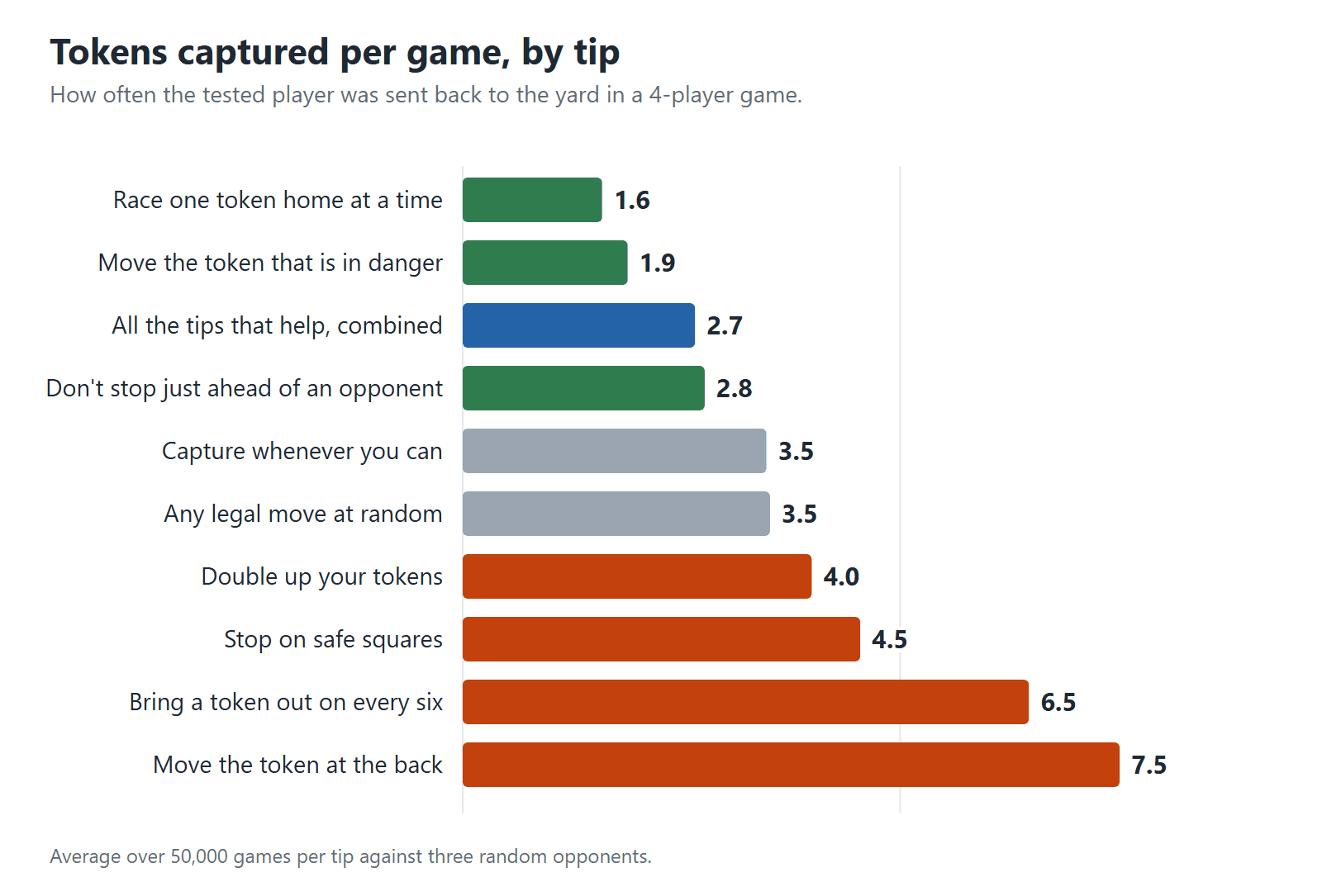
The tips that lost the most tokens are the ones that did worst. The combined strategy loses more tokens than racing one token home, but it also captures 8.4 per game, more than any single tip.
Putting them together
The combined strategy scores every legal move and plays the highest score. In plain terms, it goes through these checks:
- What does this move put at risk? For the token that moves, multiply how far it has travelled by how exposed it is, before and after the move. A token 40 squares from its start is worth protecting far more than one that just left the yard. Moves that take a valuable token out of danger score high, and moves that leave one exposed score low.
- Can I capture? A capture scores more the further the captured token had travelled, as long as it does not leave your own token badly exposed.
- Is it a six? If nothing above is pressing, bring a new token out.
- Can a token reach the home column? Nothing can touch a token there.
- Otherwise, make the move that covers the most squares.
Against three random opponents it won 64.5% of four-player games and 85.0% of two-player games. Against three copies of itself it won 25.2%, a fair share.
To see which parts matter, we took them out one at a time, and also tried simpler orders of the same rules:
- Full combination: 64.5%.
- Without capturing: 55.1%.
- Capture, else bring a token out, else the safest move: 50.5%.
- Capture, else the safest move: 49.2%.
- Without bringing tokens out: 47.0%.
- The safest move, and among equally safe moves the token furthest along: 46.8%.
- The safest move only (the "don't stop just ahead" rule on its own): 43.5%.
- Bring a token out on a six, else the safest move: 41.3%.
- Without the danger check: 30.1%.
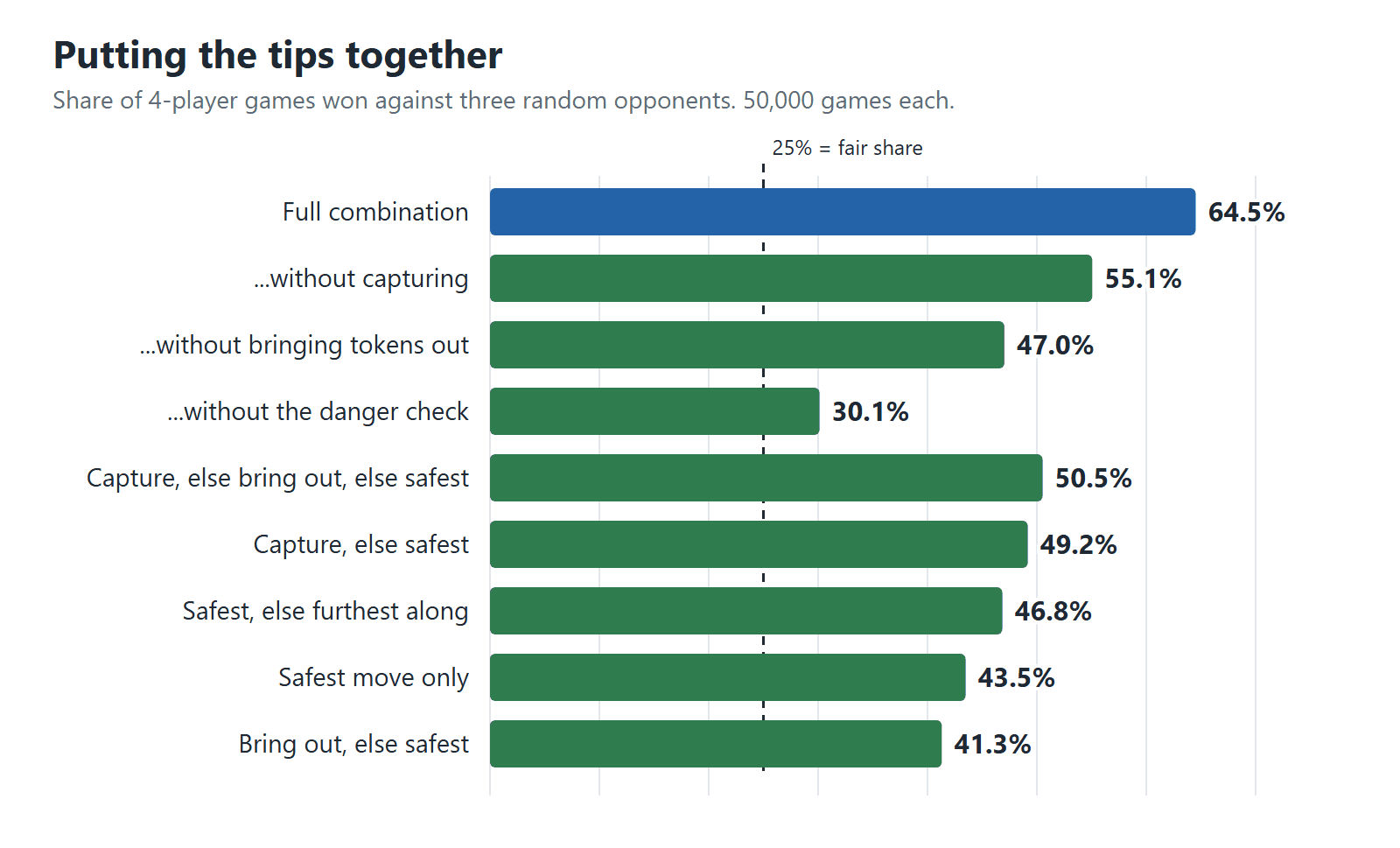
The danger check carries most of the weight. Without it the combined strategy drops from 64.5% to 30.1%, only five points above random. Bringing tokens out is worth 17.5 points and capturing about 9. The simpler orders of the same rules land between 41% and 51%. What lifts the full version another 14 points is weighing danger by how far each token has travelled, and counting the danger a move removes as well as the danger it creates.
Does going first in Ludo matter?
Going first in Ludo helps only slightly. In 200,000 simulated four-player games with all players moving at random, the player who rolled first won 25.6%, the second 25.3%, the third 24.7% and the last 24.4%, a gap of about one percentage point between first and last. With four careful players the order was the same and the gap a little smaller: 25.3%, 25.1%, 24.9% and 24.7%. In two-player games the first player won 50.8% with random play and 50.6% with careful play.
Going first is worth about half a percentage point, or roughly one extra win in 175 games. The best single tip above is worth 18 points.
How long does a game of Ludo take?
A four-player game of Ludo takes about 80 to 100 rounds, or 390 to 480 rolls of the die. At two to three seconds a roll, the pace of an on-screen game, that is roughly 13 to 24 minutes. A two-player game takes 6 to 9 minutes. On a physical board, with people counting squares by hand, expect longer.
In detail: a four-player game between random players lasted 81 rounds on average, where a round is one turn for each player, and took 387 rolls of the die. Half of the games took between 72 and 89 rounds. Games between four careful players were longer: 100 rounds and 478 rolls on average, with half between 85 and 114 rounds. Careful players capture more, 29 tokens per game against 14, and every capture sends a token back to the start.
Two-player games took 74 rounds and about 175 rolls, whether the players were careful or not. With only one opponent, captures are rare: two to four per game.
What are the odds of rolling a six in Ludo?
Each roll has a 1 in 6 (16.7%) chance of a six. Your chance of at least one six is 42% within three turns and 52% within four. Two sixes in a row is 1 in 36, and three in a row, which voids your turn, is 1 in 216. On average you wait six turns to get your first token out. The odds of still having nothing on the board:
- After 1 turn: 83%.
- After 5 turns: 40%.
- After 10 turns: 16%.
- After 15 turns: 6.5%.
Once all your tokens are back in the yard, the same wait starts again. A random player spent 11.7 rolls per four-player game with no token on the board and no six to bring one out, and another 3.4 rolls waiting for the exact number to bring a token home.
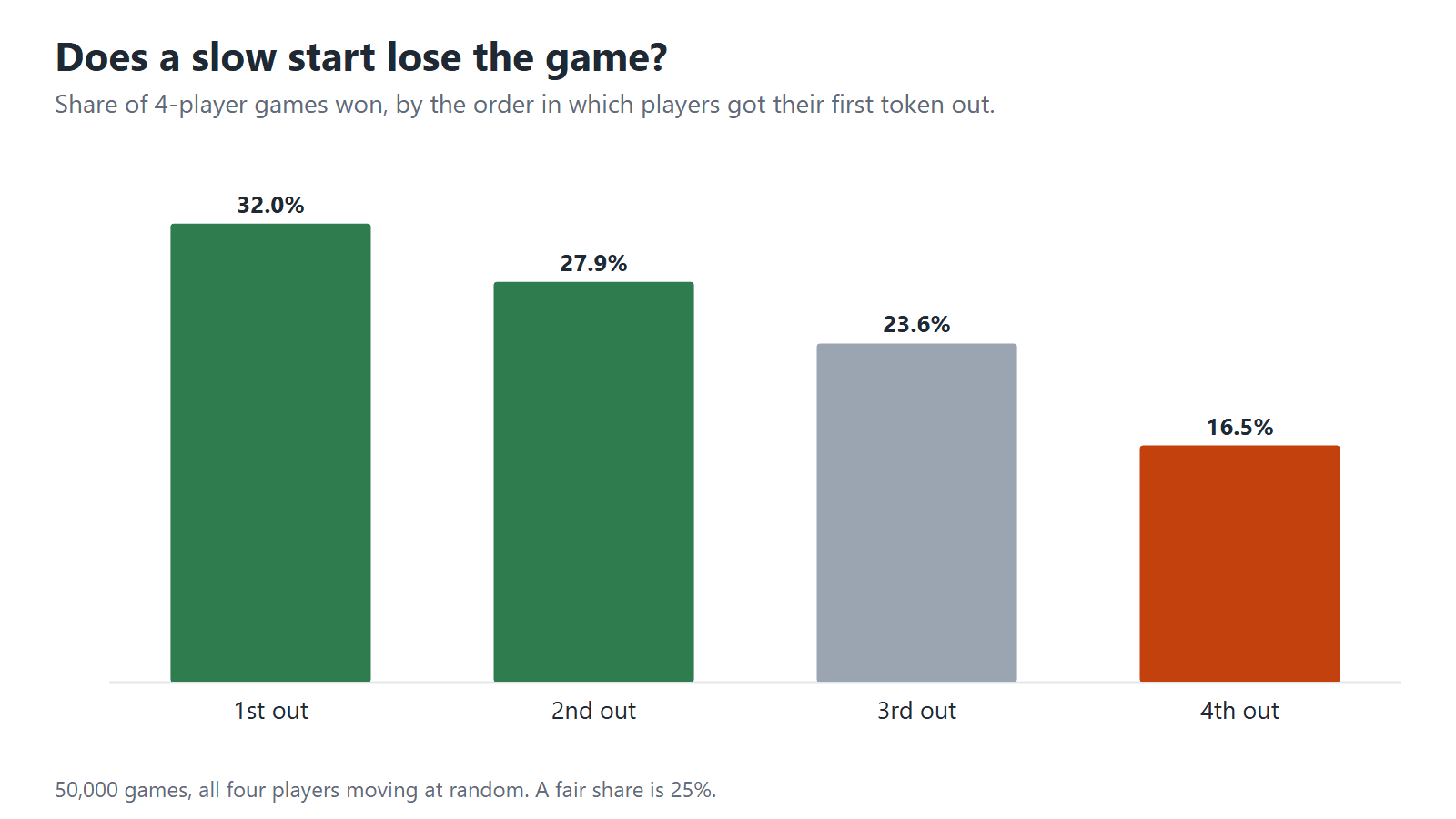
A slow start does cost something, but less than it feels like. In four-player games between random players, the player who got a token out first won 32.0% of games, and the player who got out last still won 16.5%, about one game in six.
In our four-player games, a third six in a row voided someone's turn about 1.5 times per game.
Is Ludo luck or skill?
Ludo is a mix of luck and skill. A player using our combined strategy won 64.5% of four-player games against random opponents, where a fair share is 25%, and 85.0% of two-player games. Yet a player moving completely at random still beat three careful opponents in 4.5% of four-player games, about one in 22, and won 15% of two-player games against one. In a game of pure skill, a player who moved at random would almost never beat a careful opponent.
Banerjee and Mukherjee (2024) also found a large skill effect. In their four-player, five-dice variant, an aggressive player that captures whenever it can won 89.25% of games against three naive players. Their games end after a fixed 16 turns and are scored on points, and their naive player always moves its first token. That likely makes captures worth more there than in a race to bring all four tokens home, so the figures are not directly comparable.
The question has also reached court. In India, a complaint seeking to have the Ludo Supreme app, played for money, treated as gambling was rejected by a Mumbai metropolitan magistrate's court on February 12, 2021, which called Ludo "a game of skill and not a game of chance." The complainant then took the matter to the Bombay High Court, which in June 2021 asked the state government to respond. We found no final ruling.
How to win at Ludo: six rules that work
- Look six squares behind before every move. Do not stop a token just ahead of an opponent unless you have no other choice.
- Protect the tokens that have travelled furthest. Losing a token near home costs far more than losing one that just came out. The home column is safe.
- Capture when it does not leave you exposed, and take the opponent's most advanced token when you can choose.
- Bring tokens out when nothing else is pressing, not on every six by habit.
- Don't stack tokens on our board. Without blocks, a stack is just a bigger target.
- Adjust to the number of players. With four players, keep fewer tokens on the open track. With two, capture more.
You can try them against the computer on our Ludo board, where Undo lets you go back and compare moves, or against other people at the online Ludo tables.
What the numbers leave out
- People are not random. Most of our figures are against opponents who move at random. Against three careful opponents every tip won less, though they kept almost the same order. The computer players on this site do not play like our random opponents either.
- House rules change the answer. Blocks, an extra roll for capturing or for reaching home, or letting a token out on a one as well as a six would all change these numbers. Doubling up in particular is a different tip when blocks exist.
- One roll ahead. Our strategies only look at the next roll. A person who remembers where everyone is and plans for the next few turns can do better.
For similar tests on other games, see Mahjong Solitaire Strategy, Tested on 170,000 Deals and Can Every Solitaire Game Be Won?
Sources
- Tathagata Banerjee and Diganta Mukherjee, Skill Dominance Analysis of Two(Four)-player, Three(Five)-dice Variant of the Ludo Game, arXiv:2409.00376, 2024. Win rates for rule-based strategies in simulated games.
- Sharmeen Hakim, Ludo A Gamble Or A Game Of Skill? Bombay High Court Issues Notice To State On Plea Seeking FIR Against Makers Of Ludo Supreme App, LiveLaw, June 6, 2021.
- Ludo rules on tryboardgames.com, the rule set used for every game in this test.